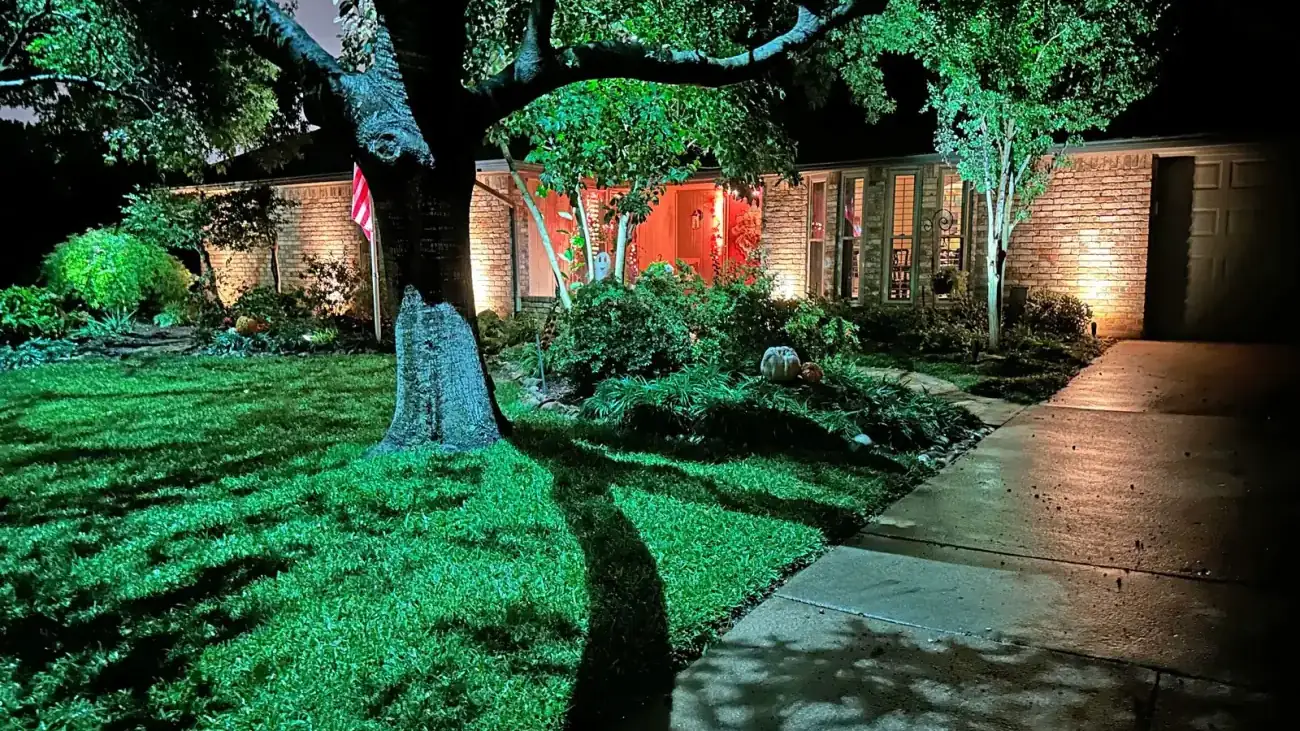
Landscape Lighting in Arlington, TX — Three Towns in One
Arlington sits on the seam between two different landscapes, and it shows up in the ground, the trees and the houses.
Arlington is the largest city in the service area that is neither Dallas nor Fort Worth, and it is the hardest one to generalise about — which is exactly why a page of generic city copy would be useless here.
It sits on the seam between the Blackland Prairie and the Cross Timbers, it was built out across seven decades rather than one, and the three broad parts of the city ask for three different approaches. Todd covers all of it, from the older streets near the centre out to the lake and the newer east side.
The Part of Arlington You Live In Decides the Plan
- Established central Arlington. Nineteen-fifties to nineteen-seventies ranch and traditional houses on generous, flat lots, with trees that are now fifty or sixty years old. This is the part of the city with the best canopy and the lowest-hanging fruit: two or three mature trees, a long low elevation to wash, and a plan that leans on downlighting.
- West Arlington, toward the lake. More contour, more Cross Timbers character, and properties that back onto water or open ground. Here the design usually runs the other way — out from the house toward a view rather than inward at the house — and the far edge of the property matters more than the frontage.
- East and north-east Arlington. The newer developments, including the Viridian side. Young planted canopy, tighter lots, heavier HOA involvement and architecture that is the feature because the trees are not big enough to be. That is a hardscape and elevation job with specimen uplighting sized for young trees, and a plan built so the downlight layer can be added when the canopy gets there.
A single fixture layout copied across all three would be wrong twice. What does carry across is the method: daylight design visit, written plan, fixed price with a start and completion date, conduit-run wiring, day-set as it goes in and a night-set on most projects.
Arlington Sits on the Seam Between Clay and Sand
The geology boundary that runs through the Metroplex passes through Arlington rather than around it, which means the ground genuinely varies across the city. The eastern side leans toward the expansive Blackland clay that Dallas is built on — shrinking in drought, swelling after rain, taking buried cable and staked fixtures along with it. The western side leans toward the sandier, better-drained Cross Timbers soil that Colleyville and Flower Mound sit on, which holds a fixture's aim far better and erodes on slopes instead.
In practice that means the answer to "how often will this need re-aiming?" is genuinely different at two addresses ten miles apart, and it is one of the things Todd is reading at the design visit rather than assuming from the postcode.
Water is the other local factor. Lake Arlington, Village Creek and the drainage corridors that feed them put a lot of properties on or near ground that moves water after a storm. Where a property sheds water across a lawn or down a bank, that low line is where erosion exposes shallow cable, and it is the first thing to look at when part of an existing system stops working after a wet spell.
What We Have Photographed in Arlington, and What We Have Not
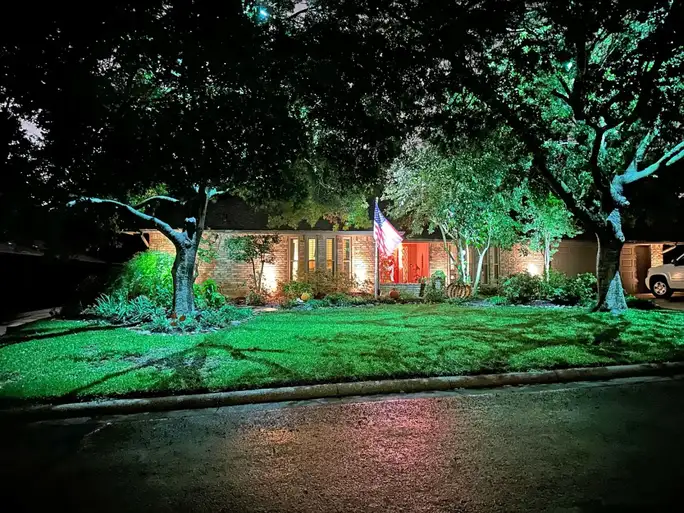
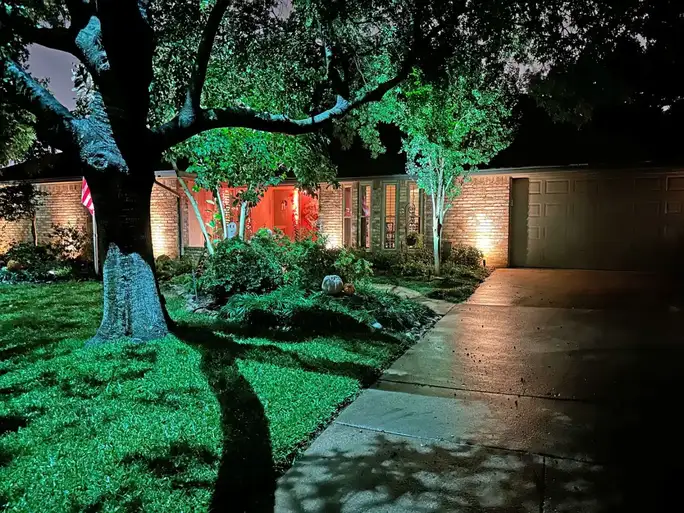
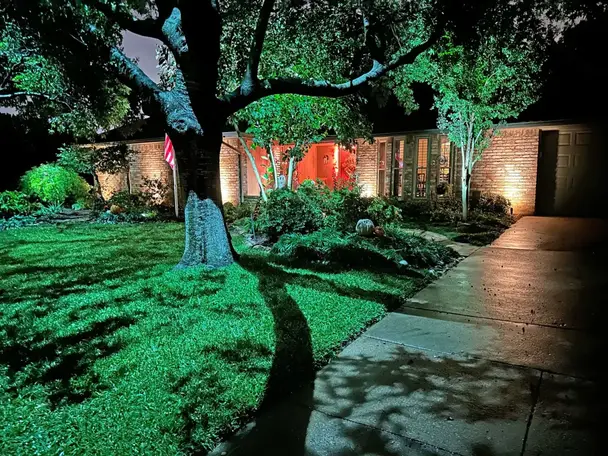
Three Arlington projects are in the photo library, which is fewer than Colleyville or Flower Mound and a great deal fewer than Preston Hollow. We would rather say that than pad this page with photographs from somewhere else and let the captions do the lying.
What the rest of the library does show is a large volume of work on exactly the kinds of property Arlington has: mature-canopy lots in the established neighbourhoods, sloped and water-adjacent sites, and newer builds where the architecture carries the design. The gallery is grouped by town so you can look at the nearest comparable work rather than taking our word for it, and the reviews page carries thirty client letters in full.
If you are in Arlington and want your property to be the fourth photograph on this page, the design visit is free and Todd comes out himself.
Lighting a Lot That Backs Onto Something
A good share of Arlington properties back onto water, a creek corridor, a greenbelt or open ground, and that changes the brief more than any other single factor. On a lot surrounded by other lots, lighting works inward: the house and the garden are the subject and the boundary is where you stop. On a lot that opens onto something, the best view at night is usually outward, and the temptation is to floodlight it.
That almost always backfires. Light thrown at open ground or water mostly disappears — there is nothing close enough to bounce it back — so you get glare in the foreground, a bright fence line, and a black void beyond that is darker than it was before you started, because your eyes are now adapted to the bright bit.
What works instead is layering toward the edge and stopping short:
- Keep the terrace and near garden at a genuinely low level, so the eye stays adapted to the dark and the view survives.
- Light the last thing that is actually yours — a specimen tree, a stand of trunks, a retaining wall — and let that be the frame. Beyond it, nothing.
- Shield anything near the boundary, especially over water: a lake or a creek reflects and carries glare a long way, and on a shared shoreline that is everybody's problem.
- On the slopes toward Village Creek and Lake Arlington, remember the same fall that gives you the view also moves water after a storm — wire crossings get routed and buried with that in mind.
Photographed After Dark in Arlington
Three photographed Arlington projects so far. The nearest larger sets are Fort Worth and Colleyville. Every one is a TC Lighting installation, shot on the property at night — no stock imagery and no renderings. Click any of them to see it full screen.
Arlington, TX — and How Far It Is From Us
Almost exactly midway between Dallas and Fort Worth, and on the seam between two different landscapes. Free on-site design visit, and Todd comes out himself.
Arlington, TX · inside the TC Lighting service area · free on-site design visit
All Eight Services, Available in Arlington
Landscape lighting is the bulk of the work, but it is not all of it. Every service below is available on a Arlington property, from the same crew and the same licensed Texas electrical contractor.
Landscape Lighting
Design and installation — uplighting, moonlighting, path and specimen work.
Read more →Holiday Lighting
Seasonal install, maintained through the season, taken down and stored.
Read more →Permanent Festive LED
Govee-type colour-changing track set into the eave line. Invisible by day.
Read more →LED Conversion & Retrofit
Halogen to LED on an existing system, keeping the runs and fixtures worth keeping.
Read more →Pole, Site & Hardscape
Car parks, drives, steps, walls and seating areas, residential and commercial.
Read more →Interior Lighting
Inside work from the same licensed electrical contractor.
Read more →Ring Camera Installation
Cameras and doorbells fitted and wired properly.
Read more →Repair & Maintenance
Diagnosing and rebuilding failing systems, including ones we did not install.
Read more →Or start here: the home page for the whole picture, about Todd Cormier for who turns up, the photo gallery for the work itself, reviews for what clients say, and contact to reach us directly.
Arlington Landscape Lighting Questions
Three projects are photographed and in the gallery. That is fewer than several nearby towns and we would rather say so than pad the page with photographs taken elsewhere. The method and the crew are the same wherever the property is.
Yes. Arlington sits almost exactly midway between Dallas and Fort Worth, squarely inside the area we work. Travel affects scheduling rather than willingness — work further out gets planned as continuous days on site rather than spread across a fortnight.
Because Arlington straddles a real geological boundary. The eastern side tends toward expansive Blackland clay, which shrinks and swells and drags fixtures out of aim; the western side tends toward sandier Cross Timbers soil, which holds aim better but erodes on slopes. Todd reads which one he is standing on at the design visit.
Start at the low line where water leaves the property. Erosion on a bank or a drainage corridor is what exposes and then damages shallow-buried cable, and a wet spell is when it shows. That is also the argument for conduit and for routing runs with the contour rather than straight across it.
Yes, but the plan should be honest about what is there. Young trees cannot carry a moonlighting layer, so the design leans on the architecture, the hardscape and the levels, with specimen uplighting sized to the trees you actually have. The thing worth doing now is leaving capacity and a run toward the trees that will matter in ten years, so adding that layer later is an afternoon rather than a trench through a finished garden.
Where Else Todd Works Near Arlington
- Landscape lighting in Fort Worth
- Landscape lighting in Colleyville
- Landscape lighting in Mansfield
- Landscape lighting in Dallas
- What the work involves, in detail — design, conduit, day-set and night-set.
- Repair and maintenance, including systems somebody else installed.
Ask Todd About Your Arlington Property
Four fields, about fifteen seconds. Send the address and what you are hoping to light. Todd walks the property himself, in daylight, and you get a written plan with a fixed price and dates before any work begins.
- Free, no-obligation design visit and written plan
- Licensed Texas Electrical Contractor — TECL 41495
- Conduit-protected wiring and daily site cleanup
- Every fixture day-set, and a night-set on most projects
Prefer to talk? Call (972) 345-1180.