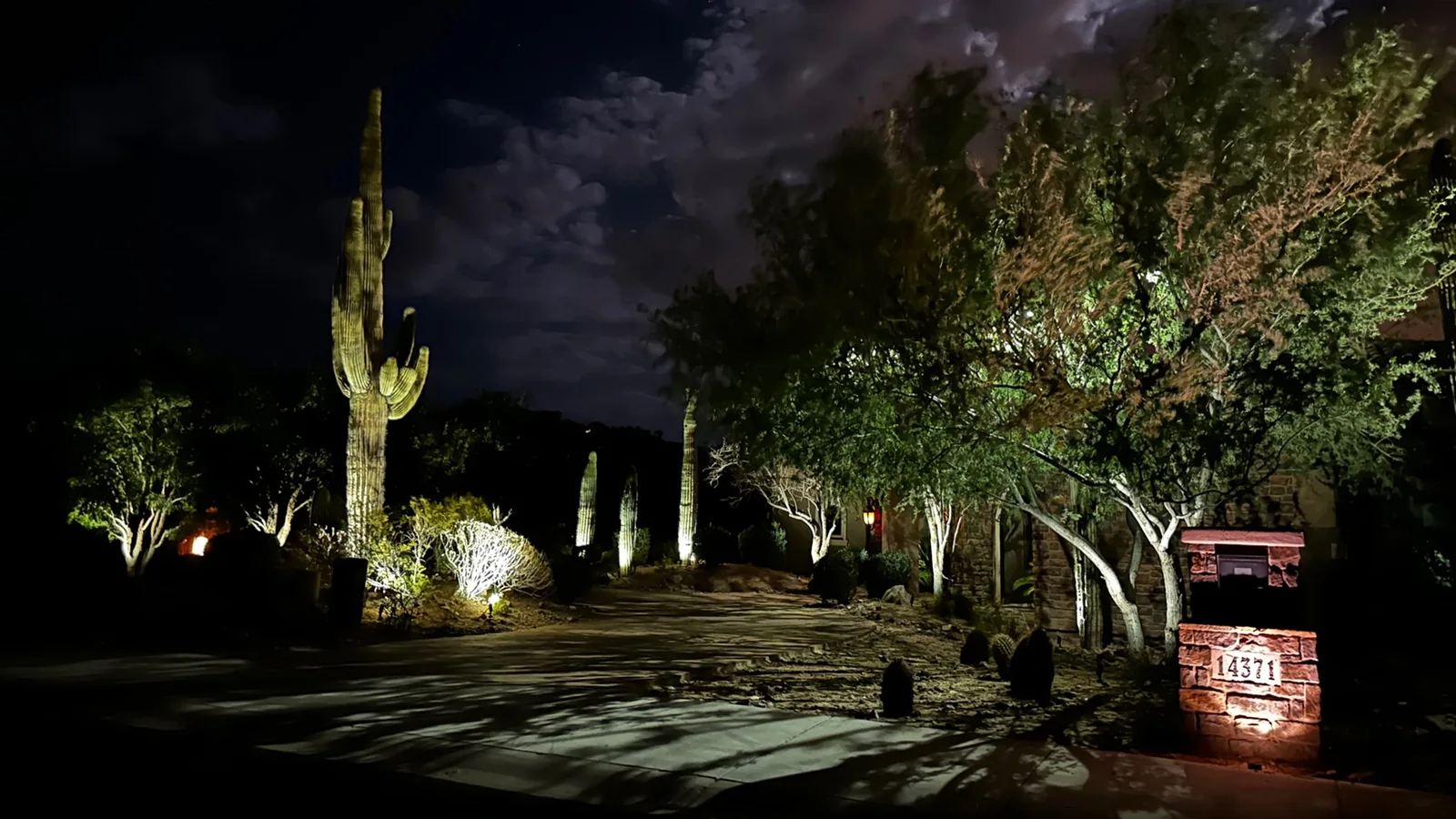
Landscape Lighting in Scottsdale, AZ — Built for the Sonoran Desert
Sun, caliche and a protected night sky change what is worth building. Todd Cormier designs every project himself — and drives out to do it.
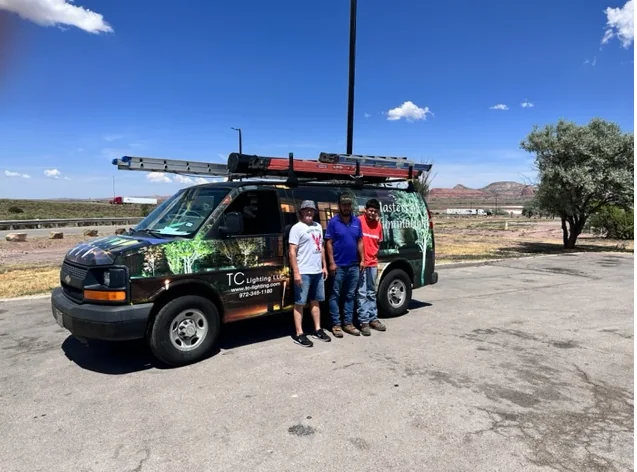
A Thousand Miles From Dallas–Fort Worth, and Worth the Drive
TC Lighting is a Dallas–Fort Worth company. Scottsdale is the one place outside Texas we keep going back to, because clients there keep asking us to — and because the desert is genuinely interesting to light.
When we come, we come properly: our own van, our own crew, our own materials. Todd Cormier walks the property in daylight and designs it there, the same as he would in Preston Hollow, and he is on site while it is being built. The difference is the schedule. An Arizona project is planned as one continuous block rather than spread across a few weeks, so the earlier you tell us about a date you are working towards, the easier it is to hold it.
What follows is not a Texas page with the city name swapped out. The sun, the ground and the sky here all behave differently, and they change what is worth building.
Sonoran Sun Is an Engineering Problem, Not a Weather Report
Scottsdale gets on the order of three hundred sunny days a year, and from May through September the UV index sits at eleven or above — the top of the scale, the band where the forecast stops giving you a number and just says extreme. A landscape lighting system lives outdoors in that for its entire life. It is the single biggest difference between a fixture's rated life and the life it actually gets.
What fails, and in what order, is predictable. Powder coat goes first: it chalks, then fades, then lifts at the edges, and once it lifts the substrate underneath is exposed. Polycarbonate and acrylic lenses yellow and then go brittle, which costs you light output long before anything breaks. Silicone gaskets harden, shrink and stop sealing. Any cable jacket that sees direct sun — a run up a trunk, a leader into a fixture, a length crossing rock rather than buried under it — cracks along its length, and once it cracks the copper is on its own.
The material answer is unglamorous and it is the reason we specify the way we do: solid brass and solid copper do not have a finish to lose. They patina. A brass fixture in Scottsdale at year eight looks older than it did at year one and works exactly as well; a painted aluminium fixture at year eight looks like something you want to take out of the garden. Cast aluminium and moulded plastic are cheaper on the bid and more expensive over the life of the system, and in this sun the gap is wider than it is anywhere in Texas.
The cable jacket point is why we run conduit on desert properties even where nothing obliges us to. Sun-cracked insulation on an above-grade run is a failure that repeats every few years until somebody re-pulls the run properly.
Desert Heat Kills Drivers Long Before It Kills Diodes
People assume an LED that is rated for fifty thousand hours will give them fifty thousand hours. That number comes from a laboratory at a controlled temperature. What actually governs how long the light lasts is the junction temperature of the diode and the temperature the driver electronics run at, and in a Scottsdale summer both of those start the day higher than the lab ever tested.
Ambient air above 110°F is only the beginning of it. A well fixture or a bullet sitting in a bed of decomposed granite or rip-rap is not living in air temperature — it is sitting on a surface that has been absorbing direct sun since nine in the morning and is radiating it back all afternoon. Rock beds are thermal mass. A fixture set into one is in an oven with the door shut, and the electrolytic capacitors inside a driver are the shortest-lived component in the whole system when they are held hot.
Three things follow from that, and they drive most of what we specify here:
- A replaceable lamp beats an integrated LED. When the diode array is potted into the fixture body, a dead driver means the entire fixture comes out of the ground and goes in a skip. When the lamp is a separate module, a failure is a five-minute swap and the brass stays where it is.
- Fixture siting is thermal, not just visual. Where we have a choice between two positions that read the same at night, we take the one that is shaded at four in the afternoon.
- The transformer wants a north or east wall. Off the ground, out of the afternoon sun, with air around it. A transformer baking on a west-facing stucco wall all summer is a transformer with a shortened life and a warranty argument in its future.
None of this makes a system immortal. It makes the difference between replacing electronics on your schedule and replacing them on the desert's.
In the Desert, Dust Is the Quiet Lumen Thief
Dallas–Fort Worth takes fixtures out with water: humidity, standing water in a well light, corrosion at a connection. Scottsdale almost never does. What it does instead is quieter and easier to miss, because nothing breaks.
Fine dust settles on every lens, every day, and it does not rain often enough to wash it off. The system does not fail; it dims. Because it dims evenly and gradually across every fixture at once, the owner's eye adapts with it, and the usual conclusion a year or two in is that the LEDs must be wearing out. Most of the time they are not. The lenses are dirty, and a rag brings the property back.
Monsoon dust storms accelerate all of it — a wall of grit driven at speed finds every gasket seam, every vent, every lens edge. And the same dry air that keeps corrosion away is hard on the elastomers: gaskets and O-rings that would stay supple in Texas humidity dry out, shrink and lose their seal, which is what lets the next dust event get inside the fixture rather than settle on it.
So serviceability is a design input here in a way it is not in Texas. A flush-lens fixture you can wipe in one pass is worth more over ten years than a deeply recessed one that holds dust in a ring you cannot reach. Fixtures set where somebody can actually get to them beat fixtures buried in the middle of a cactus bed. And a property in this climate genuinely benefits from a lens wipe on a schedule — it is the cheapest lumen you will ever buy.
Monsoon Season Puts a Year of Water Through in Nine Weeks
From roughly July into September the pattern flips. Storms build off the high ground and arrive fast, and the rain that comes with them arrives all at once. The ground does not help: sun-baked desert soil and decomposed granite shed water rather than absorb it, so a storm that would soak into a Texas lawn runs across an Arizona lot instead, finds the low line, and leaves along it.
For a lighting system that means two specific vulnerabilities, and they are both about where the wire is rather than what the fixture is.
The first is erosion. Sheet flow strips the top inches off a slope, and a cable that was buried at a respectable depth in April can be sitting proud of the grade by September — exposed to sun, to feet, to a rake. The second is the washes. Most desert lots have at least one natural drainage line through them, dry three hundred days a year and carrying moving water and rock for a few hours at a time. A wire run laid straight across a wash is the most vulnerable thing on the property, and it is also the run most likely to have been put in by somebody who visited in February.
We route around a wash where the design allows it and cross it in conduit, properly deep, where it does not. Connections go above the line water is going to reach, not at the convenient height. Fixture bodies get set so they drain rather than fill. None of this is exotic — it is the same conduit-first habit we bring to every property, applied to the one season a year that tests it.
If an existing system on your property goes dark in August, the wash crossing and the eroded slope are the first two places to look. In our experience they account for far more monsoon call-outs than lightning ever does.
Caliche and Granite Do Not Trench Like Blackland Clay
This is the part of an Arizona job that surprises contractors who have only worked east of it. Much of the Valley sits over caliche — a hardpan of calcium carbonate that has cemented the soil into something close to weak concrete. It can be a few inches thick or a few feet. Above and around it you get decomposed granite, rock and buried boulders that no survey told anybody about.
A trench that takes an afternoon in Dallas clay can take a day and a half here, and there are runs that simply cannot be cut on the line you would have chosen. Real desert installations get designed around that: routes follow softer ground, cross under existing hardscape where a sleeve already exists, and sometimes take a longer way round because the short way is through rock. It is also why a bid priced on Texas trenching assumptions is a bid that is going to come back and ask for more money.
There is a second-order problem in the same ground. Decomposed granite and rip-rap beds look like they are protecting the cable underneath them, and they are not. Cable laid shallow under DG is invisible, un-markable and exactly at the depth a landscaper re-grading a bed or a homeowner setting a new agave is going to find it with a shovel. Conduit is the answer to that on day one, not on the day it gets cut — which is the same argument we make in Texas, with harder ground and a better hit rate behind it.
| Dallas–Fort Worth | Scottsdale | |
|---|---|---|
| What takes fixtures out | Water, humidity, corrosion at connections | UV, heat at the driver, dust in the seals |
| Ground | Blackland clay — heavy, but it cuts | Caliche, decomposed granite, buried rock |
| Worst season | Spring storms, hail, freeze events | Monsoon runoff, July–September |
| Cable risk | Edger, shovel, aerator | Erosion exposure, wash crossings, shovel in DG beds |
| Canopy to work with | Mature live oak — dense, holds a shadow | Palo verde and mesquite — open, sparse |
| Main design constraint | Neighbours, glare, the street | All of that, plus a dark sky the city protects |
In Scottsdale, the Night Sky Is a Design Constraint
Arizona takes light pollution more seriously than most of the country, and Scottsdale is no exception — the city has had outdoor lighting provisions on the books for a long time and it is the city, not your contractor, that sets what is permitted. Anyone designing here should be checking the current requirements with the City of Scottsdale for the specific property before anything is specified, and we do. We are not going to quote you a lumen cap or a colour temperature limit from memory on a web page; the code is the code, and it changes.
What we can tell you is how it changes the design, because it does, and mostly for the better:
- Shield everything, aim everything. A shielded fixture aimed at the thing it is lighting puts light on the target and nowhere else. That is the whole discipline, and it is also what makes a property look designed rather than floodlit.
- Less light than people expect. Desert nights are genuinely dark and the eye adapts to that. The lumen level that reads as elegant in Scottsdale is lower than the level that reads as elegant on a Dallas street with neighbours' lights either side.
- Warmer, not whiter. Warm light sits better against adobe, stucco and desert plant colour, and it is the friendlier end of the spectrum for a dark-sky community.
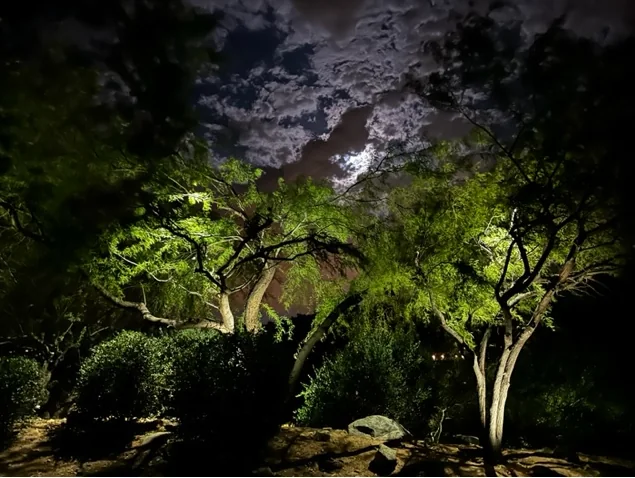
- Downlight where the plant allows it. Moonlighting — fixtures mounted high and aimed down through a canopy — is the technique TC Lighting is known for, and it happens to be the most dark-sky-respectful way to light a property. The light goes at the ground. Nothing is thrown at the sky.
- Full cutoff at the property line. Your lighting should stop where your land does.
The happy accident is that a design built to those rules is usually the better-looking design anyway. Restraint reads as expensive.
A Saguaro Is Not a Live Oak, and It Will Not Be Lit Like One
Forty years of lighting Texas live oaks teaches you to think in canopies: get fixtures up into a dense crown, aim down, and let the branch structure draw the shadow. A Sonoran plant palette gives you almost none of that. The plants are sculptural rather than voluminous, and the job becomes describing a shape instead of filling a volume.
- Saguaro. Protected under Arizona law, and structurally not something to attach anything to. Nothing gets drilled into it, nothing gets mounted on it, and nothing gets trenched through its root plate — the roots run wide and shallow, far wider than people assume. You light a saguaro from a distance with a narrow beam, grazing up the ribs so the pleats read as texture. Put a fixture at the base and you get a hot white foot and a dark top, which is the opposite of the plant.
- Ocotillo. Bare canes most of the year, leafed out for a few weeks after rain. It is a silhouette, not a mass. Backlight it or graze it from the side; front-light it and it disappears.
- Palo verde. Green bark, open airy canopy. Light passes straight through it, so it will not hold a moonlight shadow the way a live oak does. Uplighting the trunk and the main limb structure reads beautifully; expecting a dappled pool of shadow on the ground underneath does not.
- Mesquite. The closest thing the desert gives you to a moonlighting host — branchier, denser, and tall enough to mount in. Where a property has mature mesquite, that is where the downlights go.
- Agave, barrel and other succulents. All form, no interior. Cross-light them from two sides at a low angle so the rosette casts its own shadows. Flat front light turns an agave into a green blob.
The other half of the palette is the architecture, and desert architecture is generous to lighting: stucco and adobe take a wash beautifully, ramadas and deep covered patios are natural homes for downlights, and rock walls and boulder groupings grazed at a tight angle produce the kind of texture a Texas brick elevation never will.
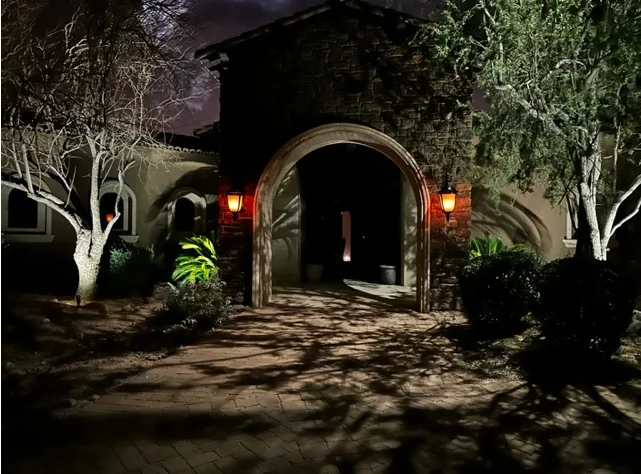
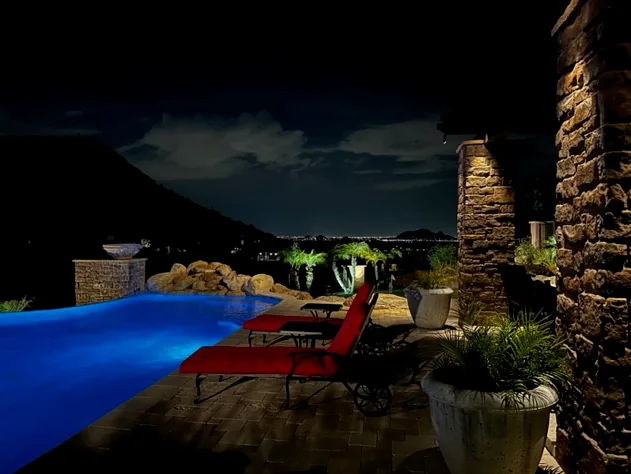
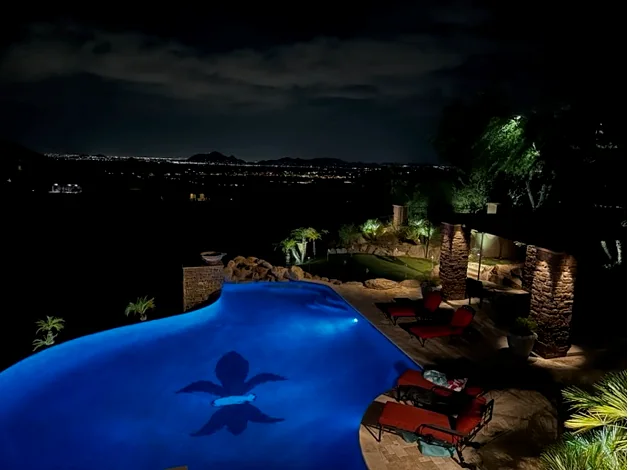
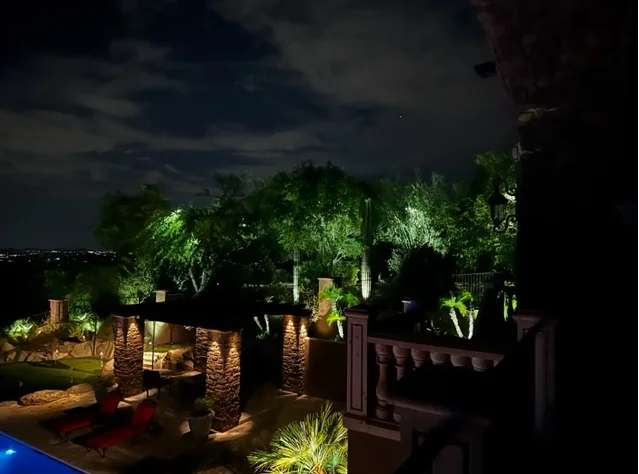
Arizona Properties, Photographed After Dark
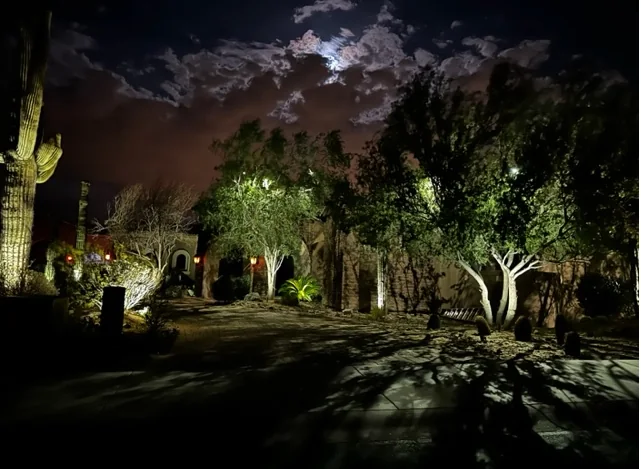
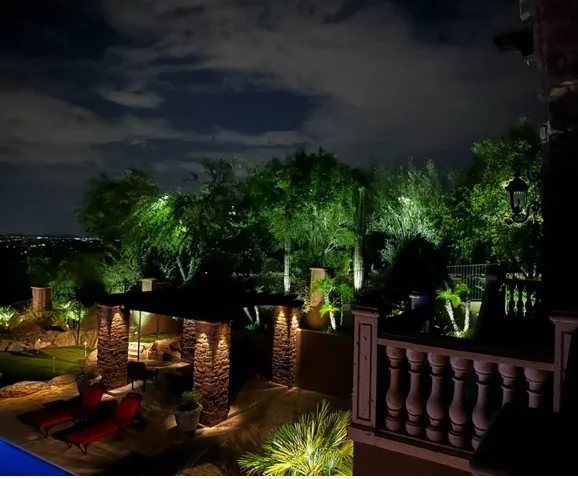
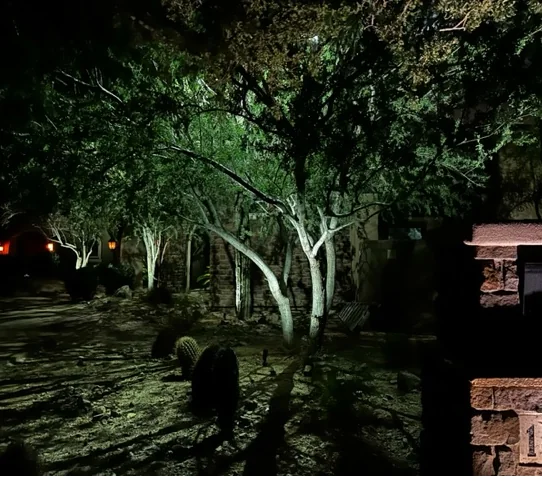
Every photograph below is a TC Lighting installation in Arizona, shot on the property at night. Click any of them to see it full screen.
We Bring the Crew, the Van and the Materials
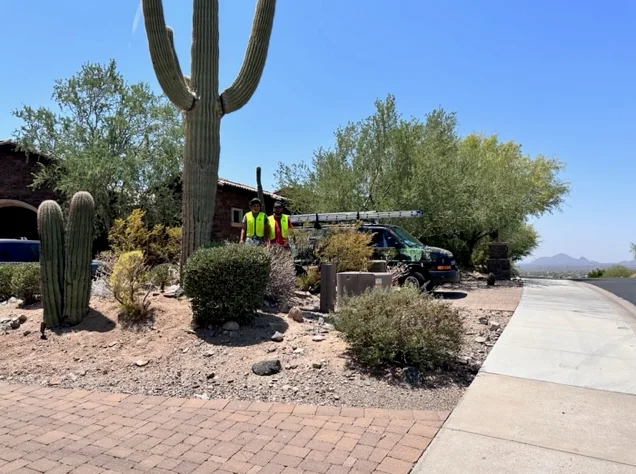
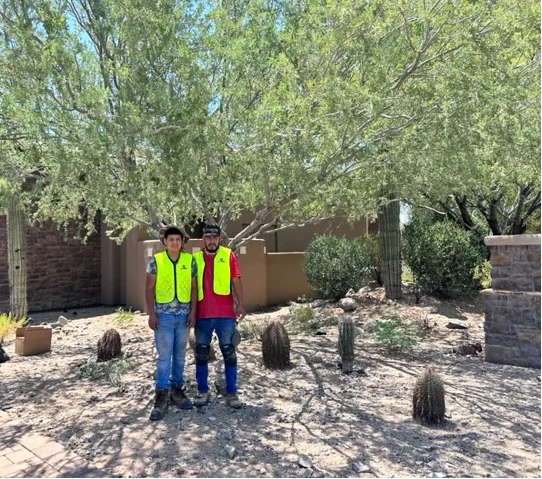
There is no local subcontractor holding your project together while we are back in Texas. The people who build a Scottsdale job are the same people who build a Colleyville one, and the van they arrive in is ours.
Scottsdale, AZ — and How Far It Is From Us
Arizona is the one place outside Texas we keep going back to, and we bring our own van and crew for it. Free on-site design visit, and Todd comes out himself.
Scottsdale, AZ · inside the TC Lighting service area · free on-site design visit
All Eight Services, Available in Scottsdale
Landscape lighting is the bulk of the work, but it is not all of it. Every service below is available on a Scottsdale property, from the same crew and the same licensed Texas electrical contractor.
Landscape Lighting
Design and installation — uplighting, moonlighting, path and specimen work.
Read more →Holiday Lighting
Seasonal install, maintained through the season, taken down and stored.
Read more →Permanent Festive LED
Govee-type colour-changing track set into the eave line. Invisible by day.
Read more →LED Conversion & Retrofit
Halogen to LED on an existing system, keeping the runs and fixtures worth keeping.
Read more →Pole, Site & Hardscape
Car parks, drives, steps, walls and seating areas, residential and commercial.
Read more →Interior Lighting
Inside work from the same licensed electrical contractor.
Read more →Ring Camera Installation
Cameras and doorbells fitted and wired properly.
Read more →Repair & Maintenance
Diagnosing and rebuilding failing systems, including ones we did not install.
Read more →Or start here: the home page for the whole picture, about Todd Cormier for who turns up, the photo gallery for the work itself, reviews for what clients say, and contact to reach us directly.
Scottsdale Landscape Lighting Questions Todd Gets Asked
Yes — with our own van, our own crew and our own materials, which is the only way a travel job is worth doing. Todd Cormier makes the design visit and is on site while the work is being built, exactly as he is on a Dallas–Fort Worth project. What changes on an Arizona job is the scheduling: the work is planned as a continuous block rather than spread across weeks, so tell us early if you have a date you are working towards.
Three things: sun, ground and sky. Extreme UV and summer heat above 110°F attack finishes, lenses, gaskets and the driver electronics far harder than anything in Texas, which changes what is worth specifying. Caliche and decomposed granite change how and where wire can be run. And Scottsdale protects its night sky, so the design has to be shielded, aimed and restrained rather than bright. The craft is the same. The engineering around it is not.
Usually the driver electronics, because heat is what ages them and a fixture sitting in a sun-loaded rock bed runs far hotter than the air temperature suggests. After that it is anything with a finish or a seal — powder coat chalking, lenses yellowing, gaskets drying out and shrinking. Dust is a separate issue: it does not break anything, it just steals output gradually until the system reads dim.
Often not. In this climate the most common cause by a distance is dust on the lenses, which builds up evenly across every fixture and dims the whole property so gradually that the eye adapts with it. Clean the lenses first. If it is still dim after that, then it is worth looking at output depreciation, voltage at the far end of a run, or a driver on its way out.
Yes, but not by attaching anything to it. Saguaros are protected in Arizona and are the wrong structure to mount to in any case. We light them from a distance with a narrow beam, grazing up the ribs so the pleating reads, and we keep trenching well clear of the root plate, which spreads much wider and shallower than most people expect.
It is the season that finds every shortcut. Sheet flow strips slopes and can leave shallow cable sitting on the surface by September, and any run laid straight across a wash is exposed to moving water and rock. We route around washes where the design allows and cross them in conduit, deep, where it does not, and we keep connections above the line water will reach.
On all of our lighting, line voltage and low voltage alike, the same as in Texas. If anything the argument is stronger here: sun destroys any cable jacket that sees daylight, decomposed granite beds hide shallow cable exactly where a shovel will find it, and monsoon erosion uncovers what was buried. Conduit is what stops all three, from the day the cable goes in the ground.
Often, yes, and on a travel job it is worth telling us up front what is already in the ground — existing sleeves, an existing transformer position or a usable run can change what the work costs. Send photographs with the address when you get in touch and Todd will tell you what is reusable before anybody drives anywhere.
Where to Go From Here
- What the work involves, in detail, on the landscape lighting page — design, conduit, day-set and night-set.
- Failing or aging system? Repair and maintenance, including systems somebody else installed.
- Older halogen system eating power in the heat? LED conversion and retrofit.
- Every photograph we have, town by town, in the photo gallery.
- Thirty client letters in full on the reviews page, and Todd's own story on about Todd.
Ask Todd About Your Scottsdale Property
Four fields, about fifteen seconds. Send the address and what you are hoping to light, and Todd will tell you straight away whether the trip makes sense for your project — before anybody talks about price.
- Free, no-obligation design visit and written plan
- Licensed Texas Electrical Contractor — TECL 41495
- Conduit-protected wiring and daily site cleanup
- Every fixture day-set, and a night-set on most projects
Prefer to talk? Call (972) 345-1180.