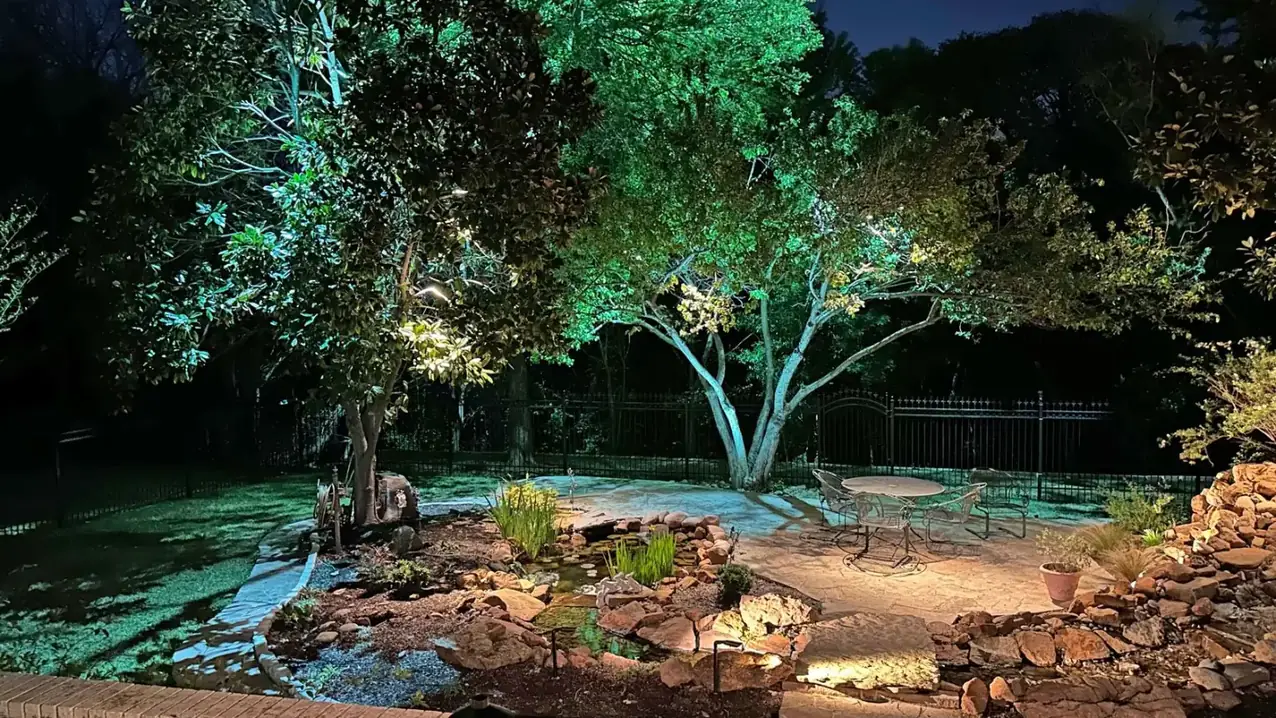
Landscape Lighting in Colleyville, TX — Acre Lots and Deep Setbacks
Fifteen photographed projects here. On a property you cannot see the end of, the skill is deciding what not to light.
Colleyville sits north-east of Fort Worth, in the run of towns between the city and DFW Airport, and there are fifteen photographed projects there in our library. It is Cross Timbers ground like Flower Mound and Keller — sandier than Dallas, kinder to a fixture's aim — but the thing that actually shapes the work here is the lot.
Colleyville grew out of rural tracts and horse property, and it kept the geometry. Acre and multi-acre lots, houses set well back behind long drives, and a lot of ground between the front kerb and the front door. That is a very different design brief from a fifty-foot Lakewood frontage, and the most common mistake on properties this size is treating more ground as a reason for more light.
On a Property This Size, the Skill Is Deciding What Not to Light
Give most installers an acre and they will fill it. Fixtures every eight feet down both sides of the drive, every tree uplit at the same intensity, the whole frontage at one flat level. The result is bright, expensive and completely without depth — the eye has nowhere to go because everything is shouting equally.
A large property wants hierarchy, and hierarchy means most of it stays dark:
- One subject, not twelve. Usually the house itself, or the best specimen tree on the lot. Everything else is lit in relation to it and at a lower level.
- Light where the eye arrives. The gate, the turn in the drive, the motor court, the front door. Between those points the drive can carry far less light than people expect and still be perfectly safe to use.
- Depth comes from contrast. A lit tree at the back of a dark lawn reads as distance. The same tree with a lit lawn in front of it reads as a flat picture. The dark ground is doing work.
- Falling levels toward the boundary. The far edges of a big lot should fade rather than stop at a hard line, which also keeps the light off the neighbours.
A useful test on any existing system: stand at the end of your own drive after dark. If you can pick out individual fixtures rather than what they are lighting, you are looking at hardware instead of at your garden.
A Two-Hundred-Foot Driveway Is an Electrical Problem Before It Is a Design One
The long approach is the signature of a Colleyville property and it is also the run that causes the most trouble. Two hundred feet of drive, sometimes with a gate at the road and a motor court at the house, means the fixtures furthest from the transformer are a very long way down the cable.
Low-voltage cable loses voltage over distance. Under-feed the far end and the last few fixtures sit visibly dimmer and warmer than the first few, which on a symmetrical drive is glaringly obvious. The old halogen version of this fault was orange lamps at the gate; the LED version hides until the drivers start flickering or failing to strike.
What it takes to get right is arithmetic before anything is buried — cable gauge chosen for each run rather than bought by the reel, hub layouts instead of one long daisy chain, and the transformer sited where the load actually is rather than wherever the nearest outlet happened to be. On the longest drives the honest answer is sometimes a second transformer part-way down, and that is cheaper than the alternative, which is a beautifully installed system that looks wrong at one end.
Gates add their own wrinkle: a powered gate usually already has line voltage run to it, which occasionally gives a sensible place to put a secondary supply. We look for that at the design visit rather than assuming it.
Pecan, Post Oak and the Trees Colleyville Kept
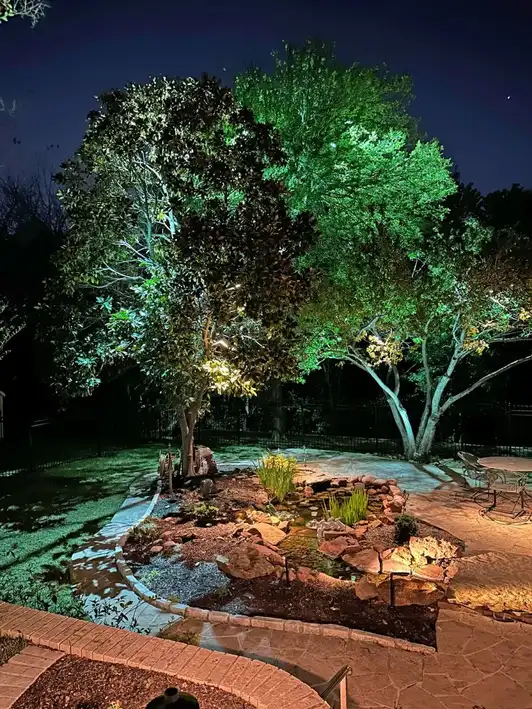
Because the lots were carved out of rural land rather than scraped flat, a lot of Colleyville properties kept their existing trees — mature pecans, post oaks and the occasional bur oak that are older than the houses around them. They are the best asset on most of these properties and they are lit very differently from one another.
- Pecan. Tall, high-branching and open, with a wide spread. A genuinely good moonlighting host: get fixtures well up into it and the light comes down over a large area with the branch pattern in it. The height is the difficulty — the useful mounting positions are a long way off the ground.
- Post oak. Lower, denser, crooked, and intolerant of root disturbance. Better uplit for its branch structure than used as a downlight host, and wire routes around the dripline rather than through it.
- Bur oak. Big leaves, coarse texture, heavy limbs. Takes an uplight well and throws a bold shadow on a wall behind it.
On a property with several of these, the plan usually uses two or three as downlight hosts and leaves the rest either uplit at a low level or dark. Lighting all of them at once is the "fill the acre" mistake in another form.
On an Acre, the Back Garden Is a Separate Destination
On a fifty-foot lot the pool is part of the back garden. On a Colleyville acre it is often a hundred and fifty feet from the back door, behind planting, with a cabana or an outdoor kitchen of its own. That distance changes it from a feature you look at into a place you go, and the two want different lighting.
A feature you look at is lit for the view from the house. A destination has to be lit for being in: enough light to use a worktop or find a step, low enough not to kill the darkness you went out there for, and a lit route to get you there and back without carrying a torch.
- Zone it separately. The frontage, the near garden and the back destination rarely want to be on at the same times or at the same levels. Splitting them is a decision made at design, because retrofitting zones means going back into the wiring.
- Light the route, not the lawn. A few well-placed markers and a downlight or two over the path beat a line of path lights marching across the grass.
- Keep it off the water. A pool surface is a mirror. Fixtures aimed across it put glare straight into the eyes of anyone sitting on the far side, which is why the good version lights the surround, the planting and the structures and lets the water reflect them.
- Watch the level at the far boundary. A lit cabana at the back of a deep lot is closer to your neighbour's fence than to your own house.
Photographed After Dark in Colleyville
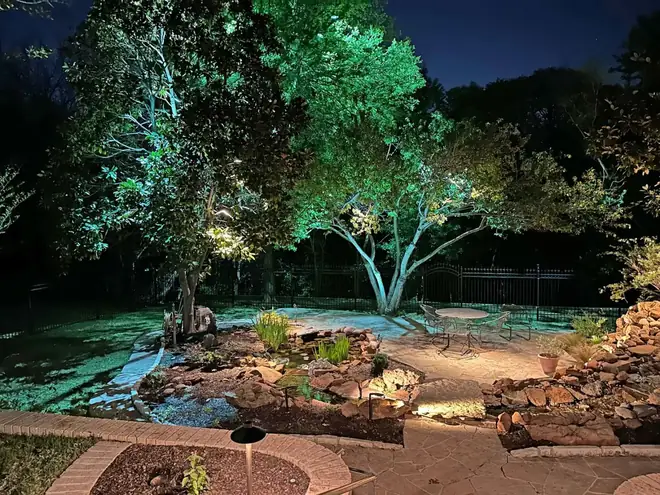
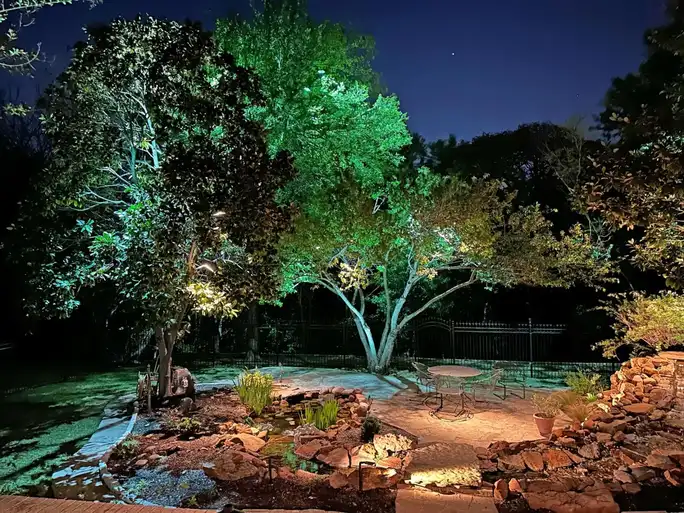
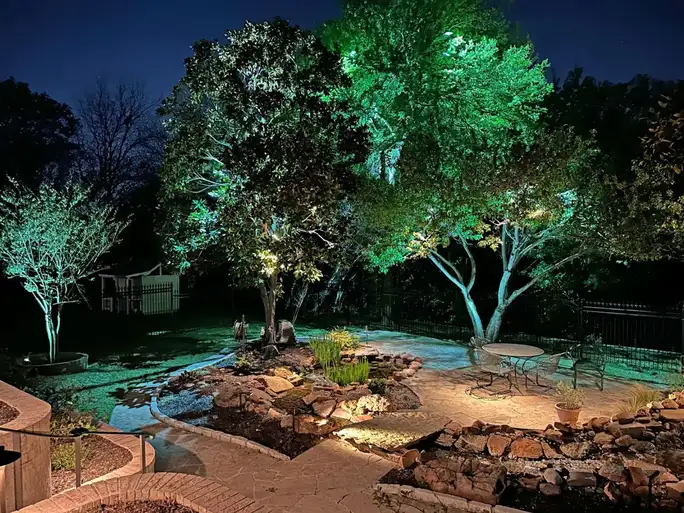
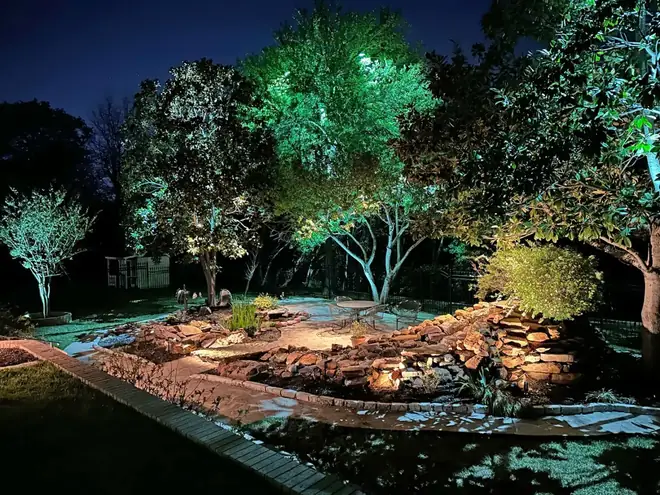
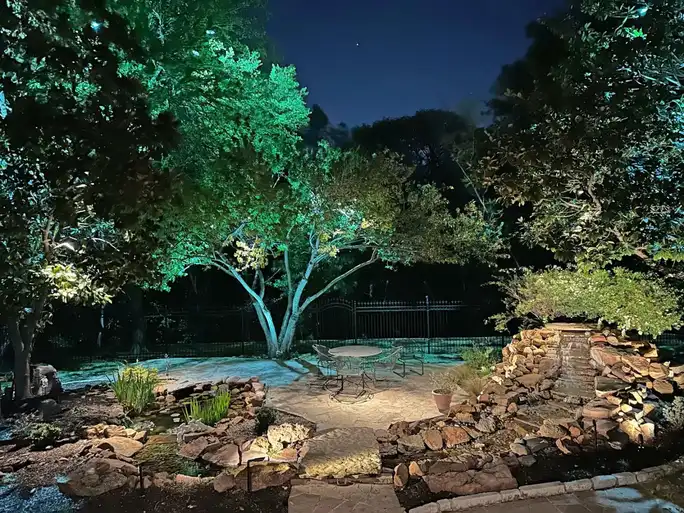
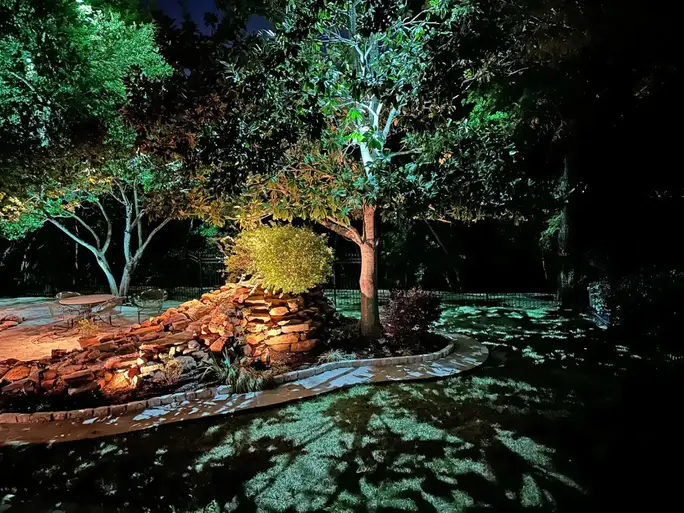
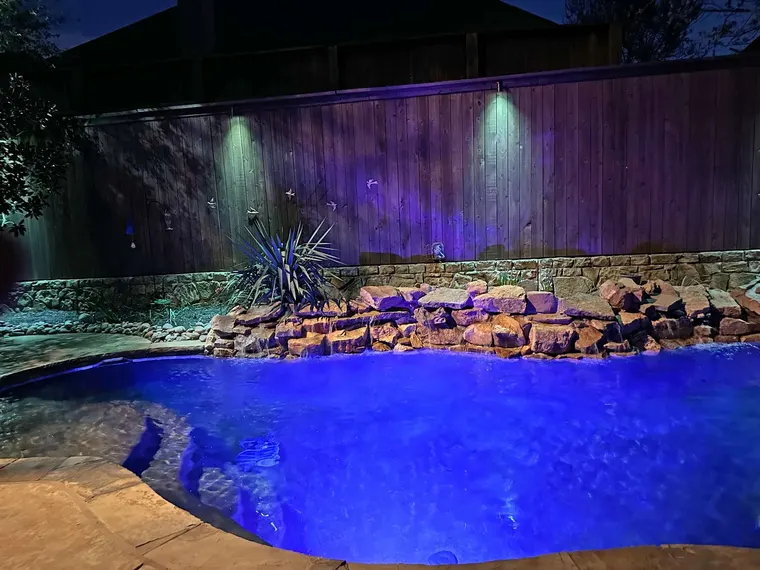
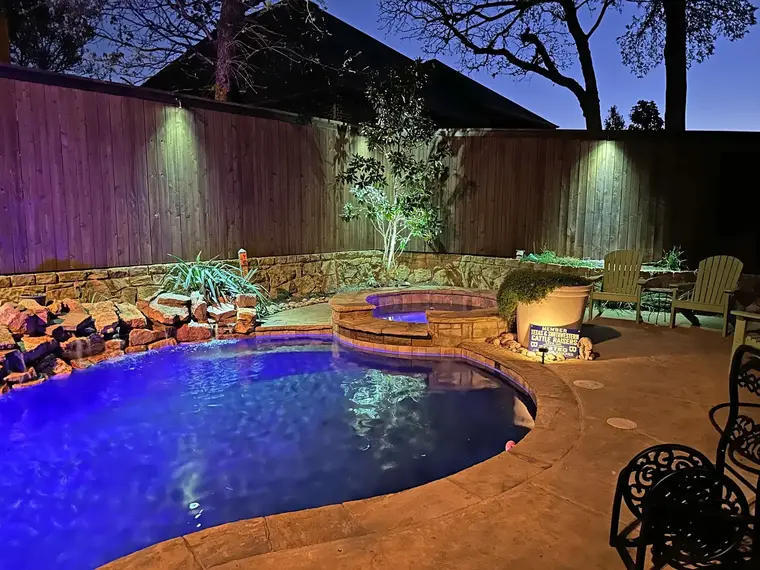
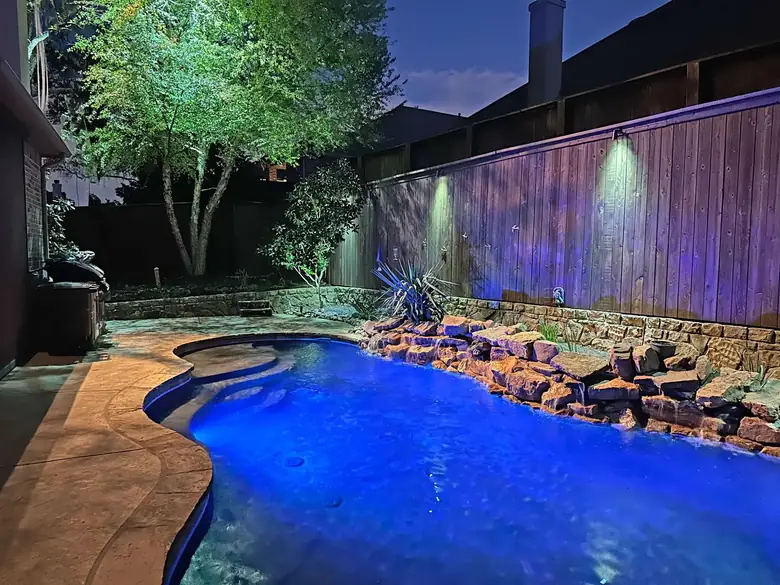
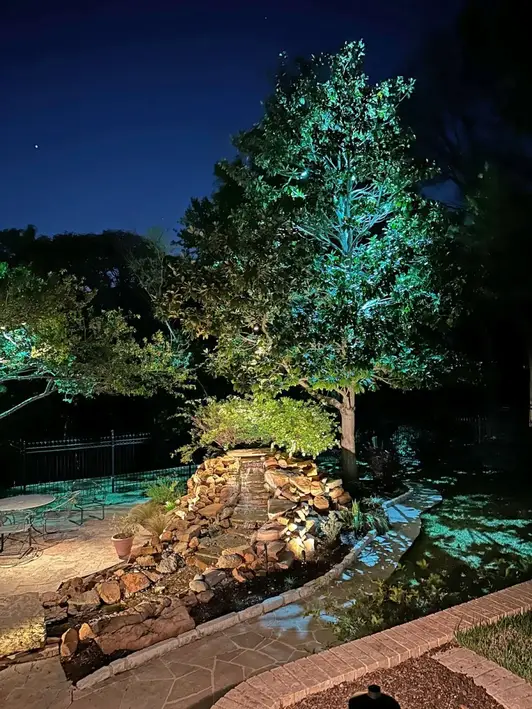
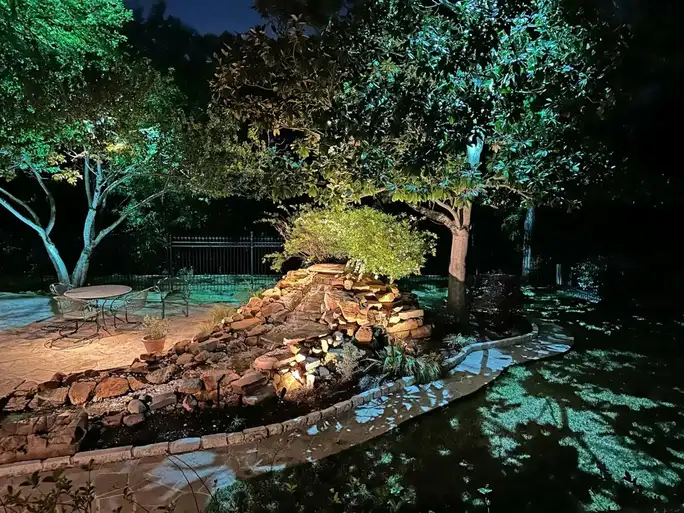
Fifteen photographed Colleyville projects are in the library. Every one is a TC Lighting installation, shot on the property at night — no stock imagery and no renderings. Click any of them to see it full screen.
Colleyville, TX — and How Far It Is From Us
North-east of Fort Worth, in the run of towns between the city and DFW Airport. Free on-site design visit, and Todd comes out himself.
Colleyville, TX · inside the TC Lighting service area · free on-site design visit
All Eight Services, Available in Colleyville
Landscape lighting is the bulk of the work, but it is not all of it. Every service below is available on a Colleyville property, from the same crew and the same licensed Texas electrical contractor.
Landscape Lighting
Design and installation — uplighting, moonlighting, path and specimen work.
Read more →Holiday Lighting
Seasonal install, maintained through the season, taken down and stored.
Read more →Permanent Festive LED
Govee-type colour-changing track set into the eave line. Invisible by day.
Read more →LED Conversion & Retrofit
Halogen to LED on an existing system, keeping the runs and fixtures worth keeping.
Read more →Pole, Site & Hardscape
Car parks, drives, steps, walls and seating areas, residential and commercial.
Read more →Interior Lighting
Inside work from the same licensed electrical contractor.
Read more →Ring Camera Installation
Cameras and doorbells fitted and wired properly.
Read more →Repair & Maintenance
Diagnosing and rebuilding failing systems, including ones we did not install.
Read more →Or start here: the home page for the whole picture, about Todd Cormier for who turns up, the photo gallery for the work itself, reviews for what clients say, and contact to reach us directly.
Colleyville Landscape Lighting Questions
Yes — fifteen photographed projects, all on the gallery page grouped by town and all shot after dark on the property. It is one of the better-documented towns in the service area.
Usually the opposite of what people expect. Big properties want hierarchy: one clear subject, light where the eye arrives, and a good deal of ground left dark so there is depth to look into. A lit tree at the back of a dark lawn reads as distance; the same tree with everything in front of it lit reads as a flat picture.
That is voltage drop, and on a two-hundred-foot drive it is the most common fault we find. It is a design problem rather than a fixture problem — correct cable gauge for the run, a hub layout rather than one long chain, the transformer placed where the load is, and on the longest drives sometimes a second transformer part-way down.
Not usually across it — around it. Runs follow bed lines, drive edges and softer ground, and they route around tree driplines rather than through them, which on a Colleyville lot with mature post oak matters a great deal. Everything goes in conduit.
Yes, and on deep lots it is easier than on small ones because there is distance to play with. Levels fall off toward the boundary rather than stopping at a hard line, fixtures are shielded and aimed, and we check the result from the road and from the neighbouring side after dark rather than only from your own front door.
Where Else Todd Works Near Colleyville
- Landscape lighting in Southlake
- Landscape lighting in Keller
- Landscape lighting in Flower Mound
- Landscape lighting in Fort Worth
- What the work involves, in detail — design, conduit, day-set and night-set.
- Repair and maintenance, including systems somebody else installed.
Ask Todd About Your Colleyville Property
Four fields, about fifteen seconds. Send the address and what you are hoping to light. Todd walks the property himself, in daylight, and you get a written plan with a fixed price and dates before any work begins.
- Free, no-obligation design visit and written plan
- Licensed Texas Electrical Contractor — TECL 41495
- Conduit-protected wiring and daily site cleanup
- Every fixture day-set, and a night-set on most projects
Prefer to talk? Call (972) 345-1180.