Landscape Lighting in Dallas, TX — Neighbourhood by Neighbourhood
Preston Hollow estates, Bluffview creek lots, Lakewood Tudors. Different ground, different canopy, different problem in each one.
Dallas is the part of the service area with the most work behind it, by a distance: fifty-five photographs across Dallas proper and Preston Hollow, most of them on properties where Todd has now been back two or three times.
What this page is not is a list of neighbourhoods with the same paragraph under each. Dallas genuinely is several different lighting problems. A one-acre Preston Hollow lot with eighty-year-old live oaks and a circular drive has almost nothing in common with a Lakewood Tudor on a fifty-foot lot where the only way to the back garden is the alley. The ground is the one thing they share, and it is the thing that causes most of the trouble.
Dallas Is Half a Dozen Different Lighting Problems
- Preston Hollow. One and two-acre lots, circular drives, and the best moonlighting hosts in the city — live oaks that were mature when the houses were new. The work here is mostly up in the trees: fixtures mounted high, aimed down through the crown, with the drive and the motor court taking the shadow. Long runs from the house to the back of the lot are the engineering problem.
- Bluffview. Creek lots and real elevation change, which is unusual in Dallas. Retaining walls, stepped terraces and sloped lawns give you something to graze, and the change in level means a fixture that is invisible from the house can be pointed straight at a neighbour's bedroom from below. Aiming matters more here than anywhere else in the city.
- Lakewood and the M Streets. Nineteen-twenties and thirties Tudors and Craftsman cottages on narrow lots with alley access and enormous pecans overhead. Small frontages mean low lumen levels and tight beam control; the canopy is the feature and the house is the backdrop, which is the reverse of how most people assume it works.
- Devonshire, Greenway Parks and the old planned blocks. Laid out in the twenties and thirties with parkway trees and deep front lawns. The parkway canopy is usually the town's, not yours, which shapes what can be mounted where.
- The estate streets off Walnut Hill and Northwest Highway. Newer large builds where the architecture is the subject: limestone, stucco and glass that take a wash rather than a graze.
Two of the enclaves inside Dallas have their own pages, because they are their own cities with their own rules: Highland Park and University Park. Preston Hollow has one too, because there is enough work there to fill it.
Blackland Clay Moves, and a Lighting System Moves With It
Dallas sits on the Blackland Prairie: a deep, dark, expansive clay that changes volume with its moisture content. In an August drought it shrinks and cracks — cracks you can lose a tape measure in — and after a wet spell it swells back. Foundations in this city are repaired for a living because of it.
Lighting is lighter than a house and moves more freely. Over one wet-dry cycle a staked uplight that was aimed dead centre on a trunk ends up a few degrees off, and a few degrees at thirty feet is a metre of miss. Path lights that were set level in April lean by September. None of it is a fault; it is the ground doing what this ground does.
What we do about it:
- Depth and backfill matter more than usual. A fixture set in a shallow scrape in clay will walk. Set properly, with the spoil compacted back around it, it holds far longer.
- Conduit rides out the movement. Bare cable in clay gets stretched and pinched by soil that is physically moving; in conduit it is free to sit still.
- Plan on a re-aim, not a rebuild. A system in Dallas clay wants somebody walking it after dark every year or two, nudging a dozen fixtures back. That is a short visit, not a project, and it is the difference between a system that looks designed at year five and one that looks tired.
Trenching has a season here. Clay cuts cleanly when it holds some moisture and turns to something close to rock in a long dry spell. A schedule written in July and a schedule written in April are not the same schedule, and we will say so rather than quietly running late.
The Trees Dallas Gives You Are Built for Moonlighting
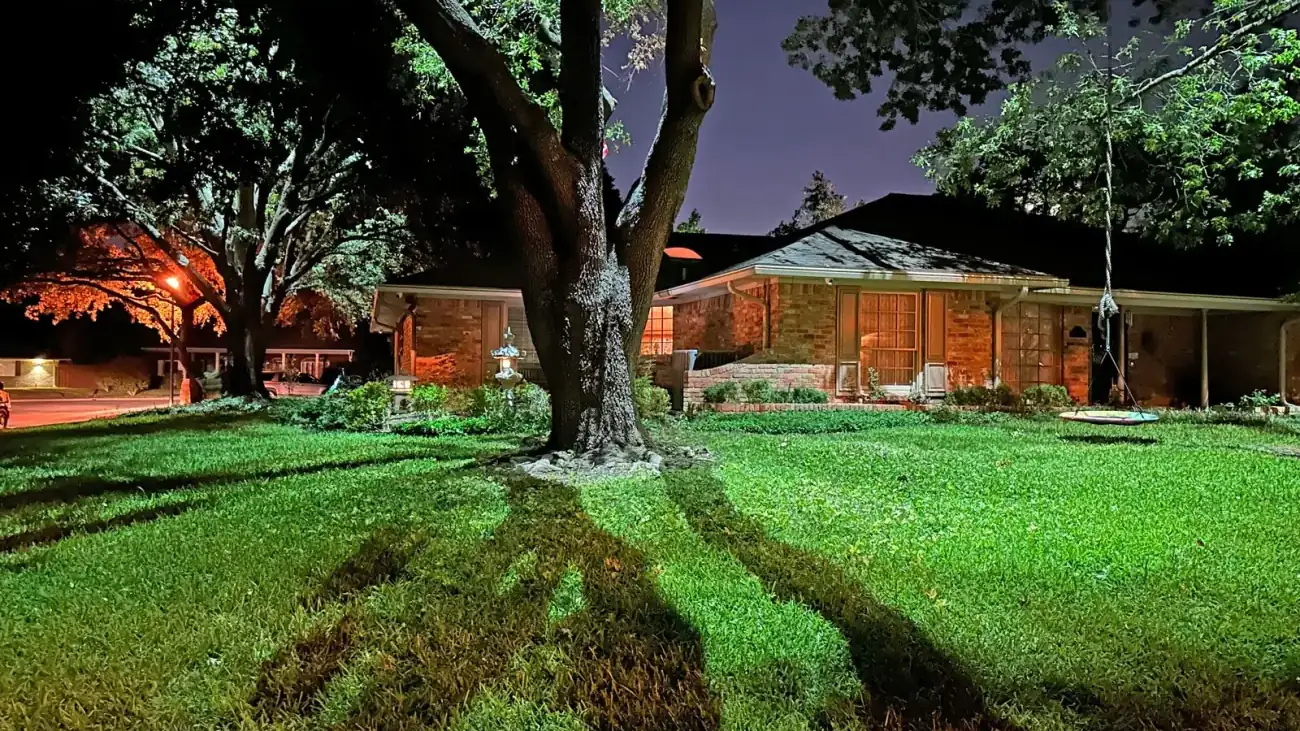
This is the good news, and it is the reason the technique TC Lighting is known for works so well in this city. The Blackland canopy is live oak, pecan, cedar elm, bur oak and red oak, and on the older streets a great many of them were planted sixty to ninety years ago. They have dense, layered crowns with real interior structure — which is exactly what you need to throw a shadow.
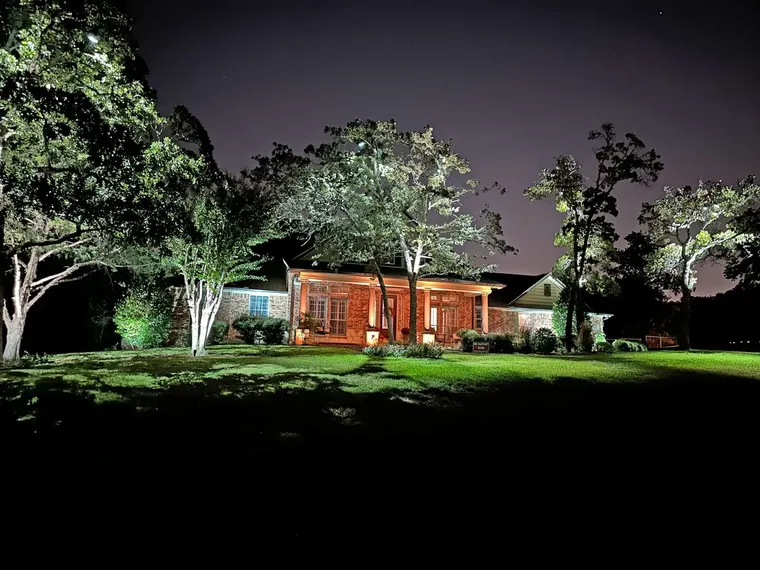
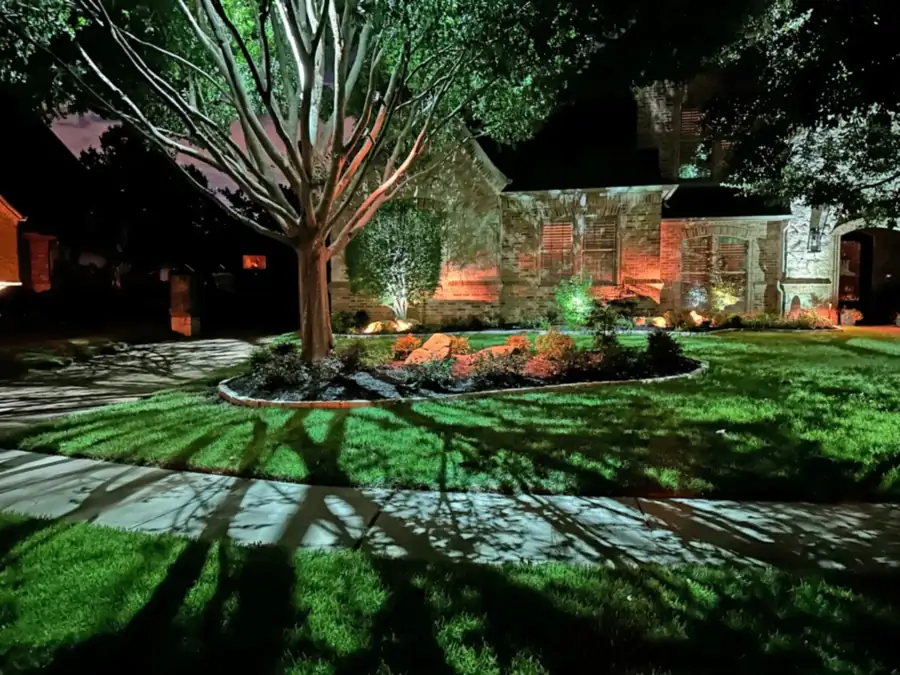
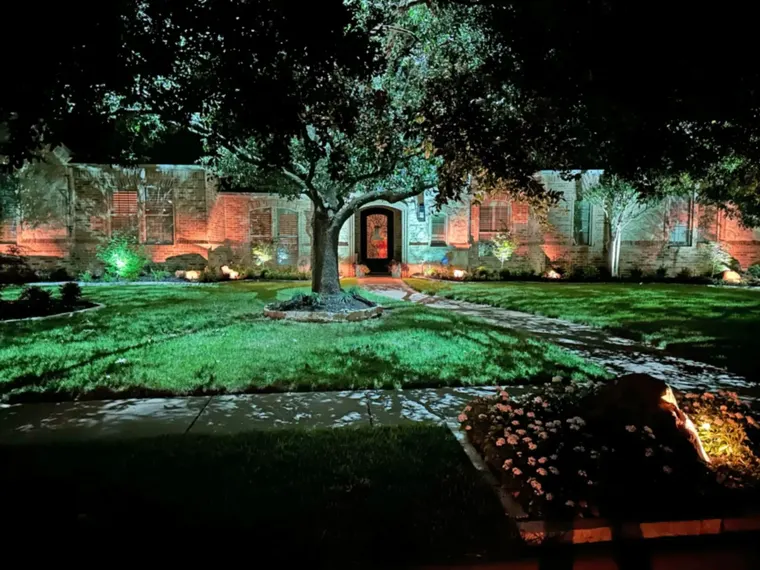
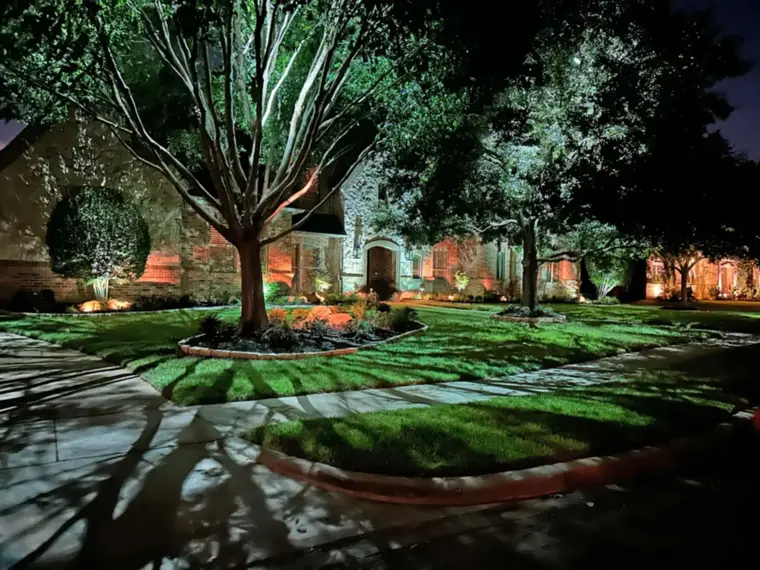
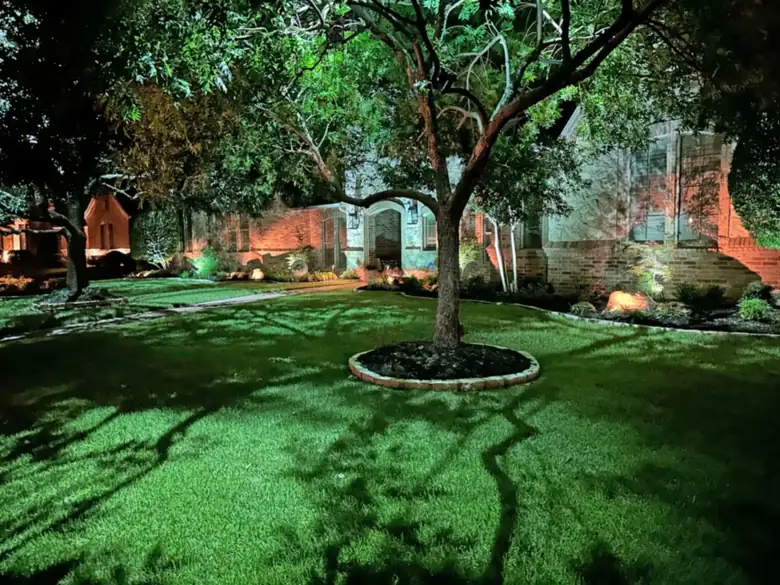
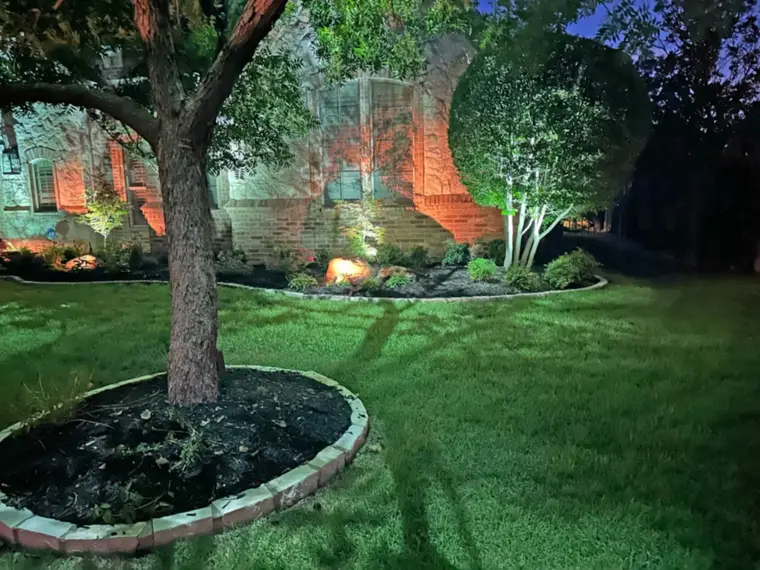
Moonlighting means putting fixtures high in a mature tree and aiming down through the branches, so the light landing on the lawn carries the pattern of the canopy with it. It reads as moonlight rather than as a lit garden. A live oak forty feet across does it beautifully. A young ornamental planted five years ago cannot do it at all, which is why the same plan does not transfer from an old street to a new one.
A working order for a Dallas property with mature trees:
- Downlights first, high in the two or three best trees. This is the layer that makes the property read at night, and it is the layer most installers skip because it means getting up there.
- Then the architecture — a wash on brick or limestone, a graze on anything with texture worth showing.
- Then specimen uplighting on trunks and forms that deserve it, at a lower level than people expect.
- Path and step lighting last, and only where somebody actually walks. Path lights are a safety device, not a runway.
On a Dallas Lot, Glare Is a Neighbour Problem
Outside the estate streets, Dallas lots are close together. A fixture aimed a few degrees high on your side fence is a floodlight in somebody's kitchen on the other side of it, and most of the complaints that reach us about other people's systems are this rather than anything technical.
Shielded fixtures, tight beams, and aiming that is checked after dark from the neighbour's side of the line as well as your own. On the alley-loaded blocks in Lakewood and the M Streets that also means thinking about the alley itself — it is a shared space, and a garage-mounted light blasting down it is the fastest way to annoy an entire block.
Several Dallas neighbourhoods are conservation districts or carry HOA architectural review, and a few have opinions about exterior fixtures on the street face. The city and the association set those rules, not us; tell us at the design visit if your street has them and the plan is built around them from the start rather than revised afterwards.
What Coming Back to the Same Dallas Houses for Twenty Years Teaches You
The thing that shows up most often in the letters clients have written is not a technique. It is duration. Several of the people whose testimonials are on this site have used Todd at two or three different houses across twenty years, and a good share of those moves happened inside Dallas — Preston Hollow to Bluffview, an older house to a new build a few streets over.
That changes how you design, and it is worth saying plainly because it is not how most of this trade works:
- Nothing is specified to survive the warranty and no longer. If you are going to see the same client in eight years at a different address, a system that looks tired at year five is a conversation you have to have.
- Serviceability beats cleverness. Fixtures that can be reached, lamps that can be changed, a transformer with room left in it. A system nobody can service is a system that gets ripped out rather than repaired.
- The system is expected to be added to. Dallas properties get pools, outbuildings, replanted beds and new terraces. Capacity and spare runs get built in, because the alternative is trenching the garden twice.
It is also why a good share of our repair work is on other people's installations. When a system fails in its first decade there is usually a reason in how it was built, and after enough of them the list of reasons gets short and familiar — bare cable, undersized runs, a transformer at its limit, fixtures nobody can get to.
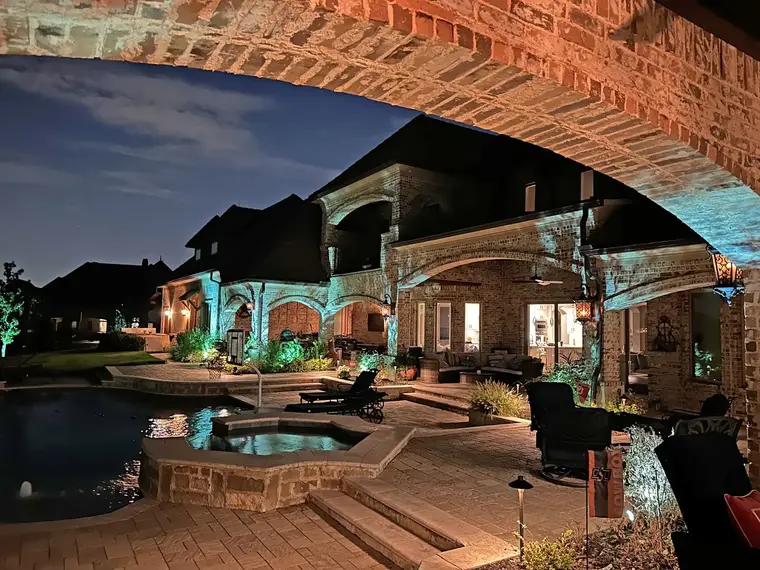
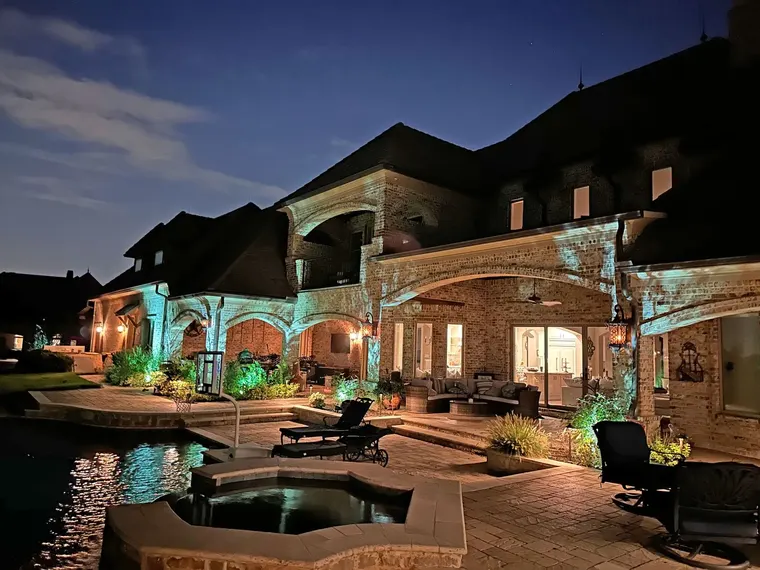
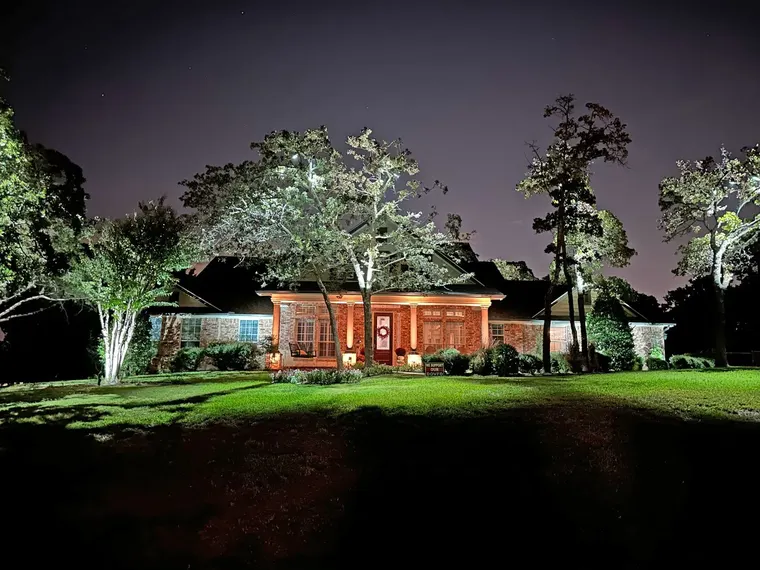
Photographed After Dark in Dallas
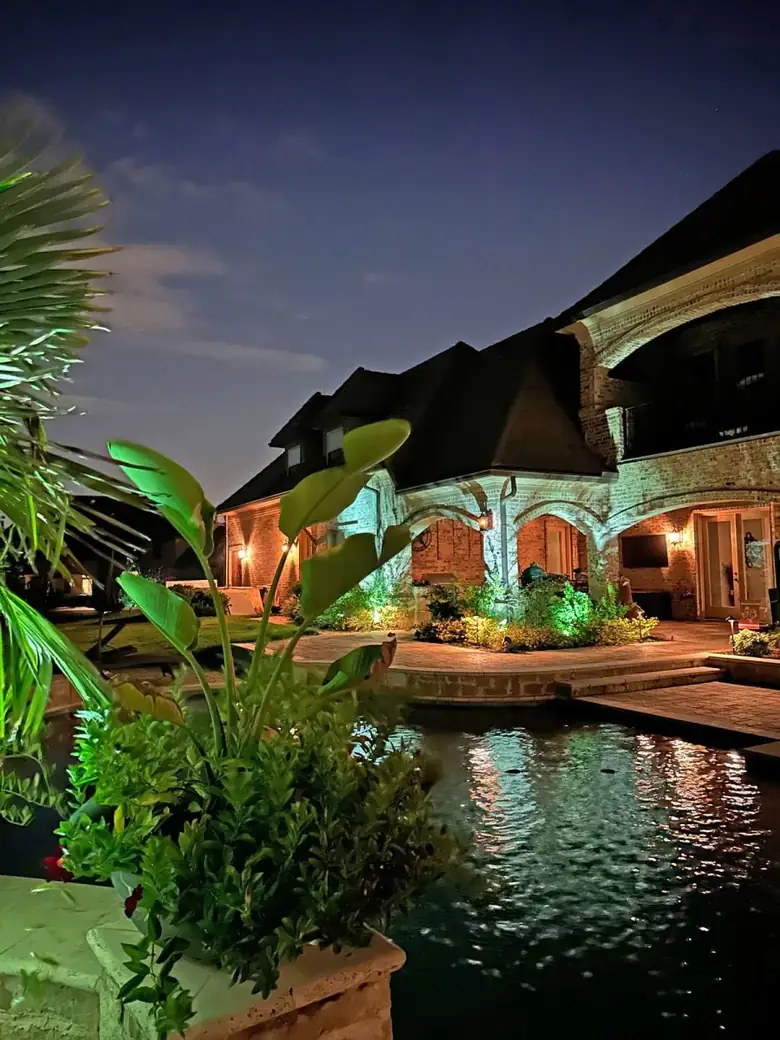
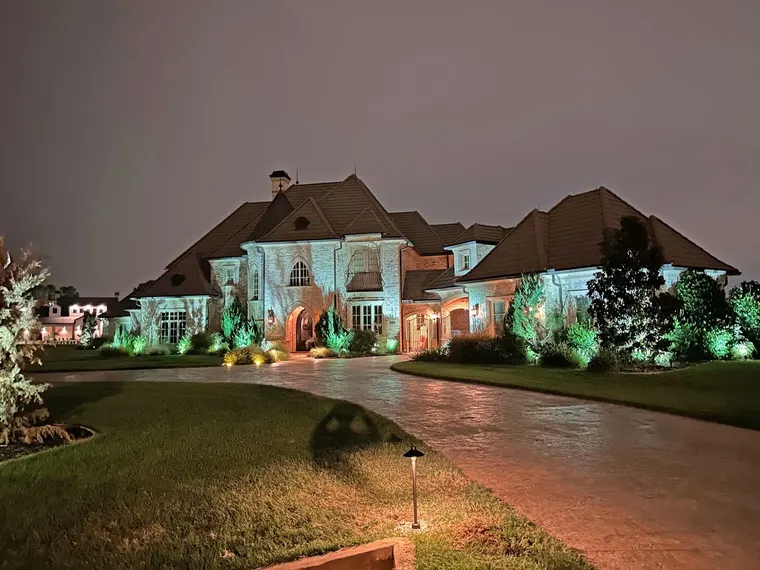
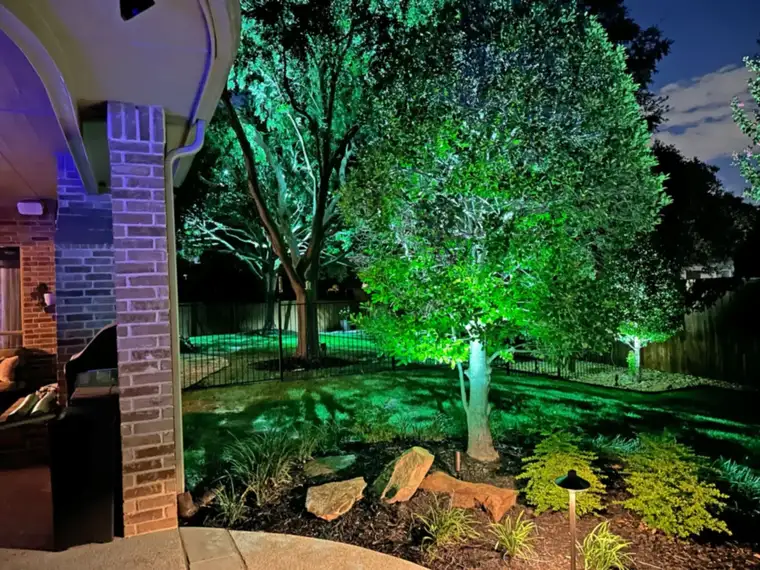
Dallas and Preston Hollow are the best-documented parts of the service area — fifty-five photographs between them. Every one is a TC Lighting installation, shot on the property at night — no stock imagery and no renderings. Click any of them to see it full screen.
Dallas, TX — and How Far It Is From Us
Fifty-five photographed projects across Dallas proper and Preston Hollow — the best-documented part of the service area. Free on-site design visit, and Todd comes out himself.
Dallas, TX · inside the TC Lighting service area · free on-site design visit
All Eight Services, Available in Dallas
Landscape lighting is the bulk of the work, but it is not all of it. Every service below is available on a Dallas property, from the same crew and the same licensed Texas electrical contractor.
Landscape Lighting
Design and installation — uplighting, moonlighting, path and specimen work.
Read more →Holiday Lighting
Seasonal install, maintained through the season, taken down and stored.
Read more →Permanent Festive LED
Govee-type colour-changing track set into the eave line. Invisible by day.
Read more →LED Conversion & Retrofit
Halogen to LED on an existing system, keeping the runs and fixtures worth keeping.
Read more →Pole, Site & Hardscape
Car parks, drives, steps, walls and seating areas, residential and commercial.
Read more →Interior Lighting
Inside work from the same licensed electrical contractor.
Read more →Ring Camera Installation
Cameras and doorbells fitted and wired properly.
Read more →Repair & Maintenance
Diagnosing and rebuilding failing systems, including ones we did not install.
Read more →Or start here: the home page for the whole picture, about Todd Cormier for who turns up, the photo gallery for the work itself, reviews for what clients say, and contact to reach us directly.
Dallas Landscape Lighting Questions
All of it — Preston Hollow and the north side, Bluffview, Lakewood and the M Streets, the Park Cities enclaves, and south of the river. No part of the city is a stretch. The work we have photographed clusters in Preston Hollow and north Dallas, which reflects where clients have found us rather than where we are willing to go.
Almost certainly the clay. Blackland soil shrinks in drought and swells after rain, and a staked fixture moves with it — a few degrees at the base is a metre of miss at thirty feet. It is not a fault in the fixture. The fix is proper setting depth and compacted backfill at installation, and a short re-aim visit after dark every year or two.
Fixtures mounted high in a tree and aimed down through the branches, so the light on the ground carries the shadow of the canopy. It needs a mature tree with real interior structure — a live oak, pecan, cedar elm or bur oak of any age on the older Dallas streets will do it. A young ornamental will not, and we will tell you that rather than sell you fixtures for it.
That is most of the skill on a narrow lot. Lower levels than people expect, shielded fixtures, tight beams, and aiming checked after dark from the far side of the fence as well as from your own back door. On the alley-loaded blocks we look at what the plan does to the alley too, because that is shared.
Yes, and they have their own pages because they are separate cities with their own rules — see Highland Park and University Park. Preston Hollow is part of Dallas proper and has its own page as well.
Any time, but the trenching is easier when the clay holds some moisture. A long August drought turns Blackland into something close to rock and slows the digging down considerably. If you are working towards a date, spring and autumn are the kinder windows — and if your date is fixed we will tell you honestly what the ground is likely to do to the schedule.
Where Else Todd Works Near Dallas
- Landscape lighting in Preston Hollow
- Landscape lighting in Highland Park
- Landscape lighting in University Park
- Landscape lighting in Plano
- What the work involves, in detail — design, conduit, day-set and night-set.
- Repair and maintenance, including systems somebody else installed.
Ask Todd About Your Dallas Property
Four fields, about fifteen seconds. Send the address and what you are hoping to light. Todd walks the property himself, in daylight, and you get a written plan with a fixed price and dates before any work begins.
- Free, no-obligation design visit and written plan
- Licensed Texas Electrical Contractor — TECL 41495
- Conduit-protected wiring and daily site cleanup
- Every fixture day-set, and a night-set on most projects
Prefer to talk? Call (972) 345-1180.