Landscape Lighting in Keller, TX — Post Oak and Room to Spread Out
Cross Timbers ground, big lots and the most easily damaged tree in North Texas.
Keller sits just north of Fort Worth, on the Cross Timbers side of the Metroplex. Like Colleyville and Southlake either side of it, it kept the shape of the rural land it grew out of: generous lots, deep setbacks, and stands of native post oak that are older than most of the houses.
Keller's Post Oaks Are Worth Protecting More Than Lighting
Post oak is the defining tree of this part of the Metroplex and the one that punishes careless work. Its roots are shallow and spread well beyond the edge of the canopy, it has almost no tolerance for grade change or trenching inside the dripline, and it declines slowly — three or four years later, long after anyone would connect the decline to a trench. They grow slowly and transplant badly, so a mature one lost is lost for a generation.
So on a Keller property the first design decision is usually negative: where the wire is not going to go. Runs take the long way round driplines. Anything that must pass near a tree goes in by the least invasive method available rather than the fastest. Mounting hardware goes on so nothing girdles a limb as it thickens.
Lit, post oak is a different subject from the live oaks twenty miles east. The crown is more open and the limbs are crooked and characterful, so the branch structure is the feature — it takes uplighting far better than it works as a downlight host. Where a property also has pecan or bur oak, those are usually the better moonlighting trees.
Sandy Ground Holds Aim; Long Runs Lose Voltage
Two things are consistently true of a Keller lot. The soil is sandier Cross Timbers ground rather than Blackland clay, which is good news: without the seasonal shrink-and-swell cycle, a properly set fixture stays pointed where it was put, and systems here need re-aiming noticeably less often than their equivalents in Dallas or Plano. The trade-off is erosion, which moves sandy soil off slopes and can leave shallow cable sitting proud after a couple of heavy seasons.
The second is distance. On an acre-plus lot the far fixtures can be two to four hundred feet of cable from the transformer, and low-voltage cable loses voltage over that distance. Under-fed LEDs do not dim gracefully the way old halogen lamps did; they hold up and then start flickering or failing to strike. Getting it right is arithmetic before anything is buried — cable gauge chosen per run, hub layouts rather than one long daisy chain, the transformer placed where the load actually is, and spare capacity left for the pool or outbuilding that arrives later.
What This Looks Like on the Ground Near Keller
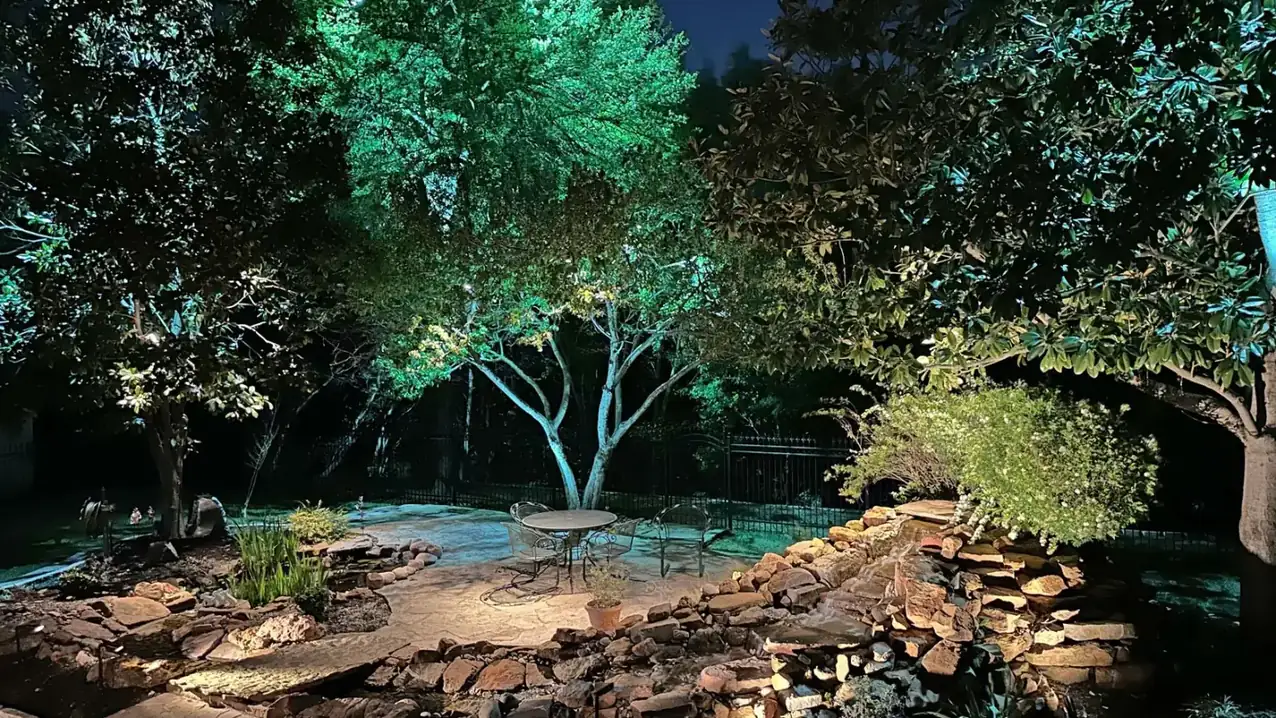
We have not photographed a Keller installation yet, so every photograph below is from Colleyville — the nearest documented work, on the same ground and the same kind of property. Each one is captioned with the town it was actually taken in. All are TC Lighting installations, shot after dark on the property. Click any of them to see it full screen.
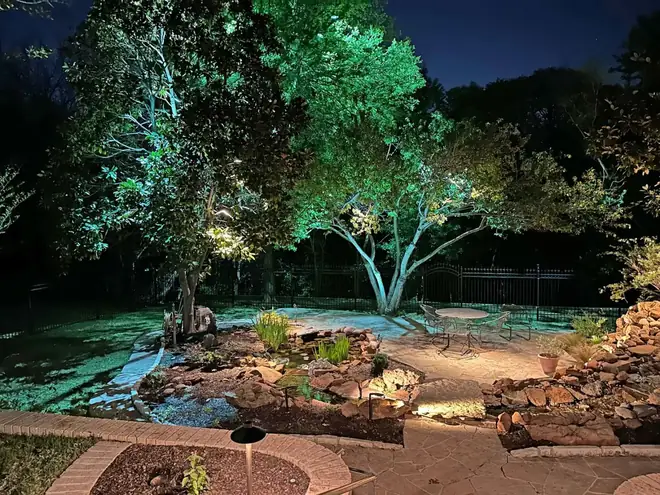
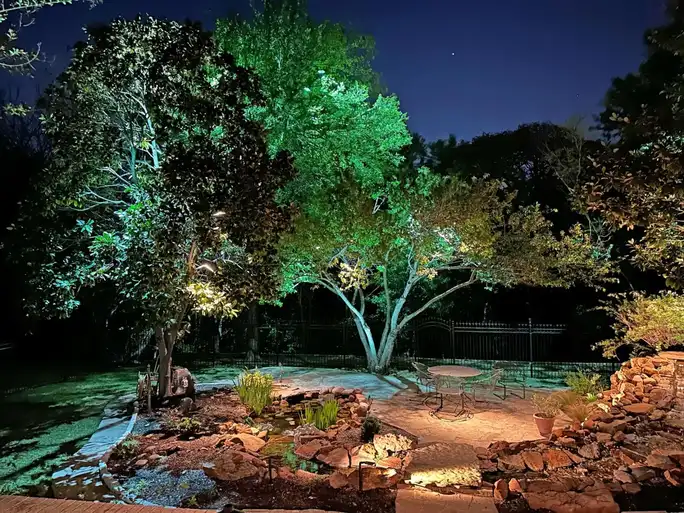
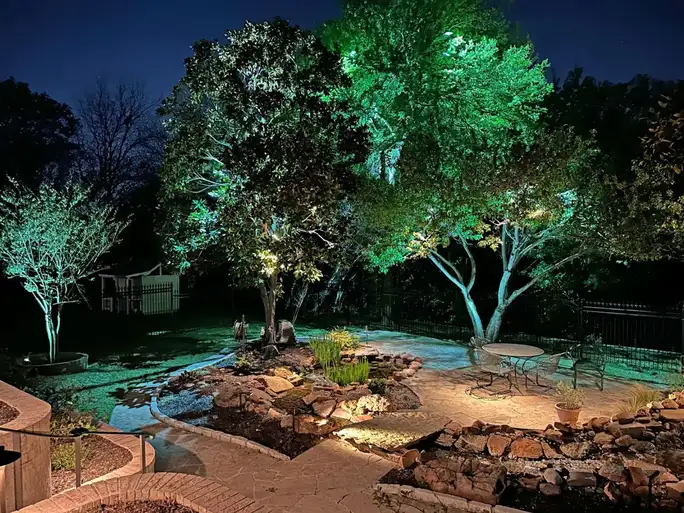
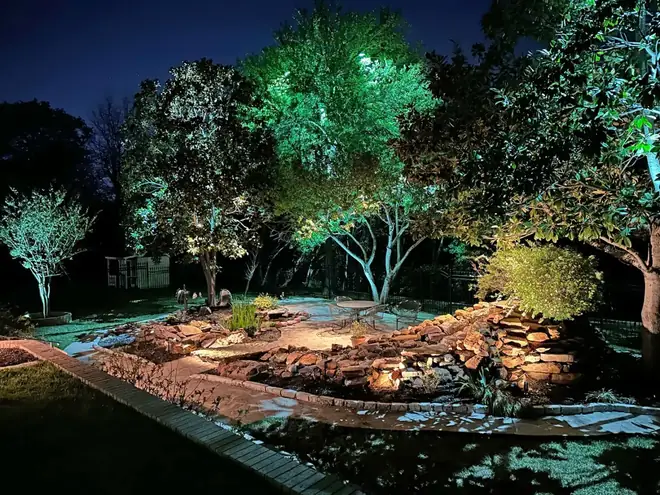
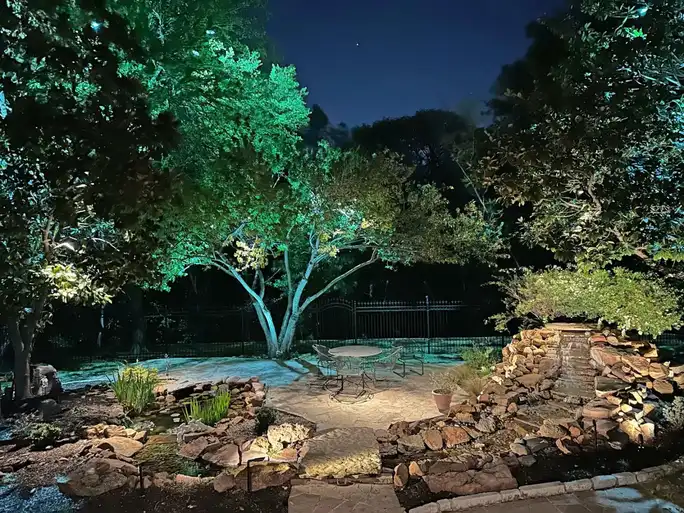
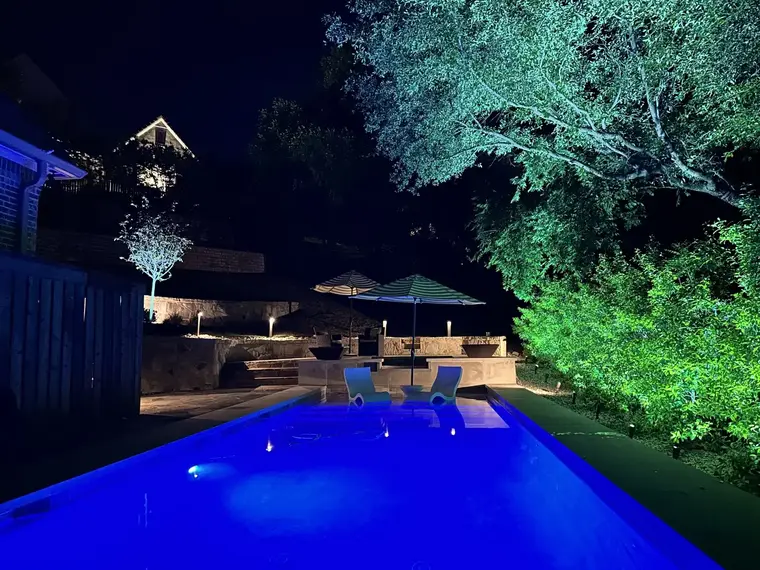
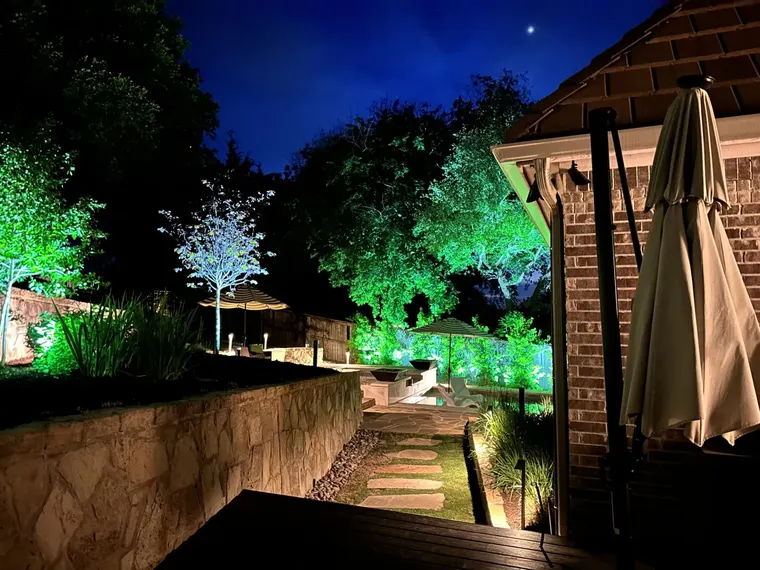
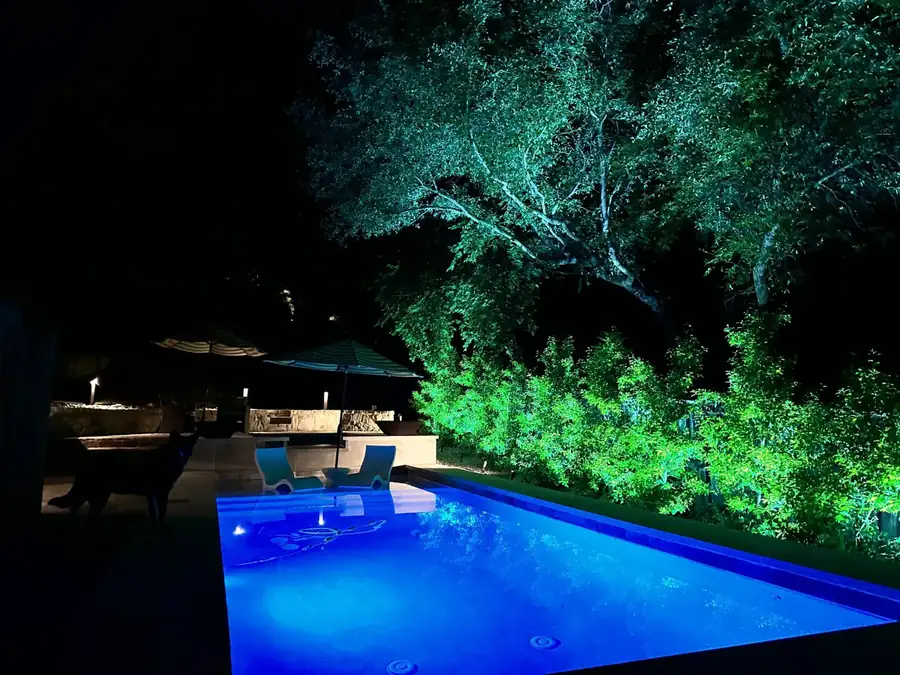
The full gallery is grouped by town, and the reviews page carries thirty client letters in full. If you are in Keller and want your property to be the first photograph on this page, the design visit is free.
Keller, TX — and How Far It Is From Us
Just north of Fort Worth, on the Cross Timbers side of the Metroplex. Free on-site design visit, and Todd comes out himself.
Keller, TX · inside the TC Lighting service area · free on-site design visit
All Eight Services, Available in Keller
Landscape lighting is the bulk of the work, but it is not all of it. Every service below is available on a Keller property, from the same crew and the same licensed Texas electrical contractor.
Landscape Lighting
Design and installation — uplighting, moonlighting, path and specimen work.
Read more →Holiday Lighting
Seasonal install, maintained through the season, taken down and stored.
Read more →Permanent Festive LED
Govee-type colour-changing track set into the eave line. Invisible by day.
Read more →LED Conversion & Retrofit
Halogen to LED on an existing system, keeping the runs and fixtures worth keeping.
Read more →Pole, Site & Hardscape
Car parks, drives, steps, walls and seating areas, residential and commercial.
Read more →Interior Lighting
Inside work from the same licensed electrical contractor.
Read more →Ring Camera Installation
Cameras and doorbells fitted and wired properly.
Read more →Repair & Maintenance
Diagnosing and rebuilding failing systems, including ones we did not install.
Read more →Or start here: the home page for the whole picture, about Todd Cormier for who turns up, the photo gallery for the work itself, reviews for what clients say, and contact to reach us directly.
Keller Landscape Lighting Questions
Yes. Keller is just north of Fort Worth, well inside the area we cover. We have not yet photographed a Keller project, and we would rather say so than imply a history that is not there. The nearest documented work is Colleyville, ten minutes south, with fifteen photographed projects on very similar ground.
It can, if it is done carelessly, and the damage shows up years later rather than at the time. Post oak roots spread wider than the canopy and hate disturbance. We route around driplines rather than through them even when that means a much longer run, use the least invasive method where something has to pass close, and mount so nothing girdles a limb.
Less so than a live oak or a pecan. The crown is more open and the limbs are crooked, so there is less structure to cast a dense shadow. That same character makes it excellent to uplight for its branch form. If your property also has pecan or bur oak, those are usually where the downlights go.
Yes. Runs of two to four hundred feet lose real voltage, and the symptom on an LED system is flicker or a fixture that will not strike rather than a gentle dimming. Cable gauge is chosen for the run, the layout uses hubs rather than one long chain, and the transformer goes where the load is, with capacity left spare.
Where Else Todd Works Near Keller
- Landscape lighting in Southlake
- Landscape lighting in Colleyville
- Landscape lighting in Fort Worth
- Landscape lighting in Flower Mound
- What the work involves, in detail — design, conduit, day-set and night-set.
- Repair and maintenance, including systems somebody else installed.
Ask Todd About Your Keller Property
Four fields, about fifteen seconds. Send the address and what you are hoping to light. Todd walks the property himself, in daylight, and you get a written plan with a fixed price and dates before any work begins.
- Free, no-obligation design visit and written plan
- Licensed Texas Electrical Contractor — TECL 41495
- Conduit-protected wiring and daily site cleanup
- Every fixture day-set, and a night-set on most projects
Prefer to talk? Call (972) 345-1180.