“I needed work done on my lights in the backyard. I called Todd who owns TC Lighting LLC. Todd came to my house to give me an estimate and I found Todd to be very knowledgable and with many years of experience. Todd also suggested lighting my three tall trees in the backyard…”

Landscape Lighting in Corinth, TX — Seven Local Projects, Between Two Lakes
A town with water on both sides, where the air itself changes what the light does.
Corinth is a small Denton County city in an unusual position: wedged between Lewisville Lake on the east and Lake Dallas on the west, with no great distance to either. It incorporated in 1960, though the ground is older than that — Alton, the county's second seat between 1848 and 1850, stood within what is now Corinth, and the post office dates from 1883.
We have photographed seven Corinth projects and they are all on this page, shot after dark on the night each system was set. Two things about the location shape the work. One is atmospheric and surprises people: with large bodies of water on both sides, the air here holds moisture, and moisture is what makes a light beam visible. The other is legal rather than optical — a good number of lots in and around Corinth end at Corps of Engineers land, and that boundary is not yours to light.
On a Damp Night Between Two Lakes, You See the Beam and Not Just What It Lands On
A light beam is invisible in clear air. What you see is the surface it lands on. Put moisture or dust in the air and the beam itself starts to scatter light back at you, and the fixture stops being a hidden source and becomes a visible shaft. Anyone who has seen a security light in fog knows the effect; on a still, damp evening in Corinth you get a mild version of it several nights a month.
This is only a problem for fixtures that were going to be marginal anyway, and it is a useful diagnostic. A beam that becomes conspicuous in humid air was almost always over-powered, too wide, or aimed at nothing — a fixture whose light substantially misses its target has most of its output travelling through air rather than landing on a surface, and damp air shows you exactly that. A tight beam that lands cleanly on a trunk or a wall has very little spare light to scatter and looks the same on a damp night as on a dry one.
So the design response is not a special fixture, it is discipline that is good practice anyway: shielded optics, beam widths matched to the subject rather than oversized for safety, and aiming done on site after dark rather than assumed from a plan. We aim everything in person on a separate evening, and on lakeside properties we try to do that on a still night, because that is the condition that shows up the mistakes.
If Your Garden Ends at Corps Land, It Ends There for Lighting Too
Lewisville Lake and Lake Dallas are federal reservoirs, and the land immediately around them is managed by the US Army Corps of Engineers rather than owned by the adjoining houses. A great many lots on that edge appear to run down to the water and do not; the deeded boundary stops some distance short, and what lies beyond it is public land with its own rules about what may be placed, fixed or planted on it.
The practical consequence is simple and it is better heard at the design visit than from somebody official afterwards. We do not install fixtures, run cable or mount anything on the far side of that line, and we will say so plainly if the thing you were hoping to light sits beyond it. Where the boundary is unclear, your survey or plat is the document that settles it, and we would rather look at that than guess.
What you can do is usually better anyway. A lot that ends at open Corps land has a dark, unbuilt, often wooded edge — which, as on any dark boundary, means your garden needs less light than a lot in the middle of town to read as generous, and gains enormous depth from having genuine blackness behind it. Light your own trees from your own ground, aim inward, and the borrowed landscape does the rest for nothing.
Seven Corinth Jobs, and the Thing They Have in Common
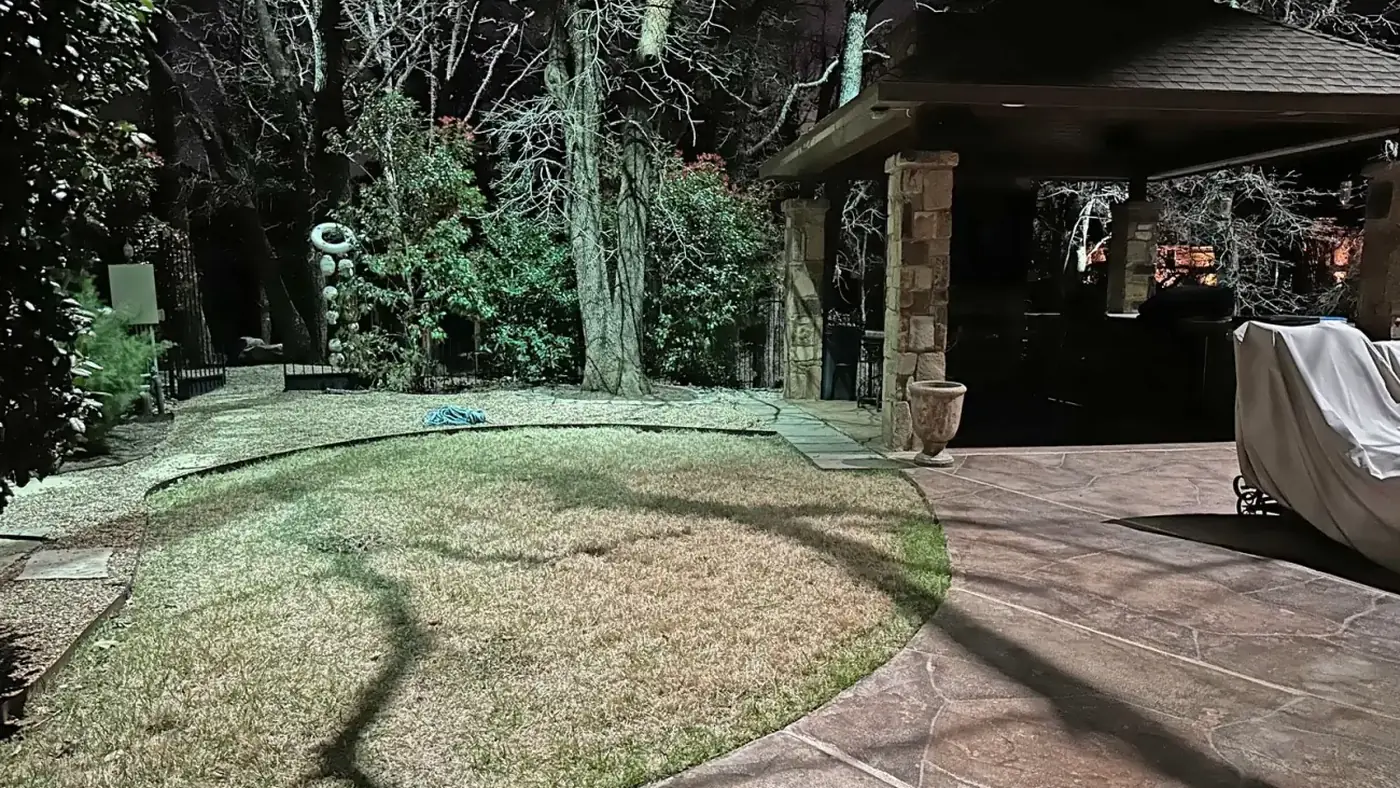
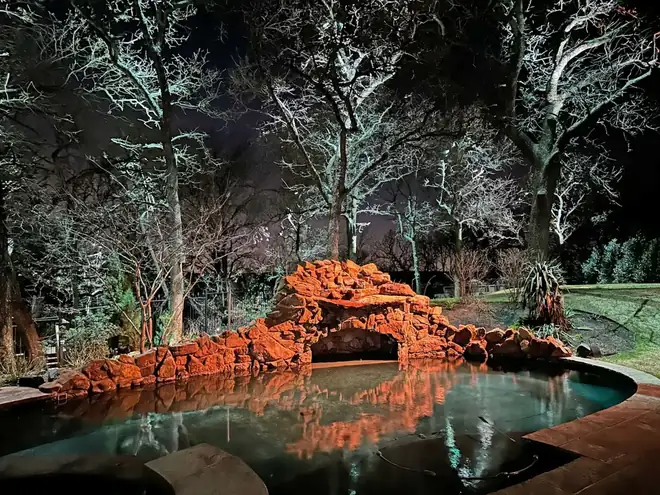
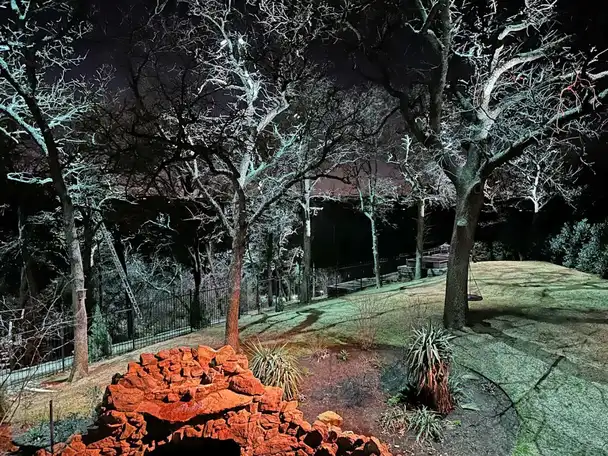
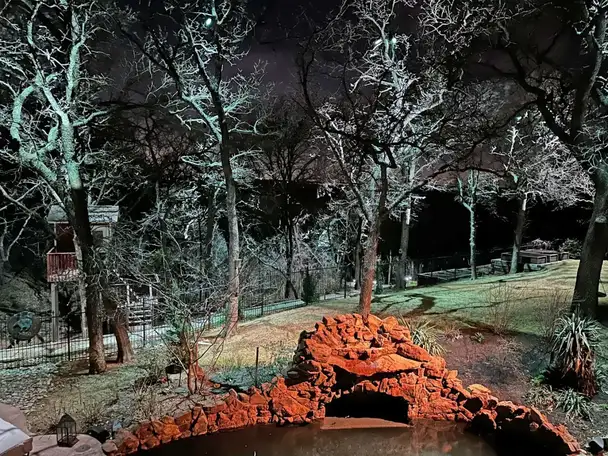
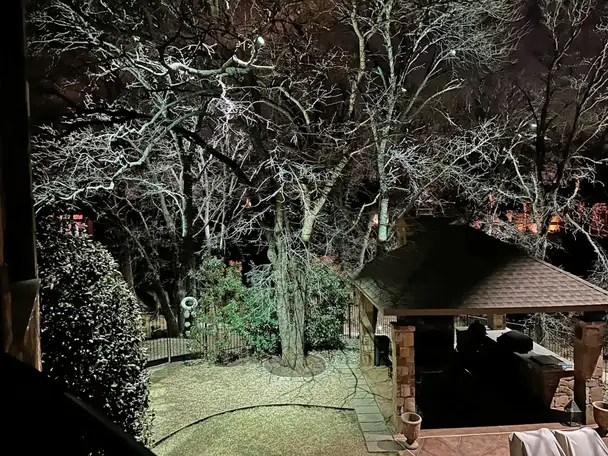
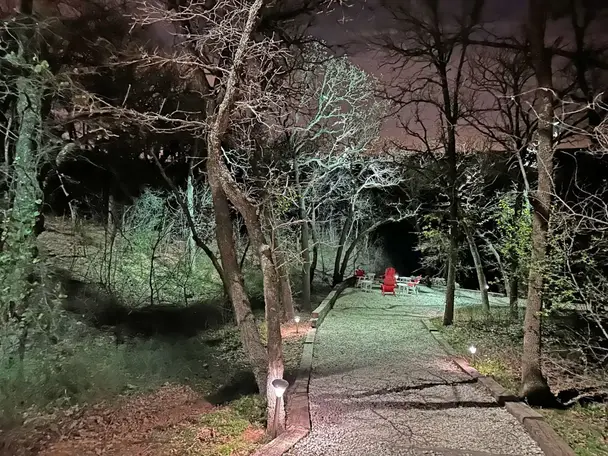
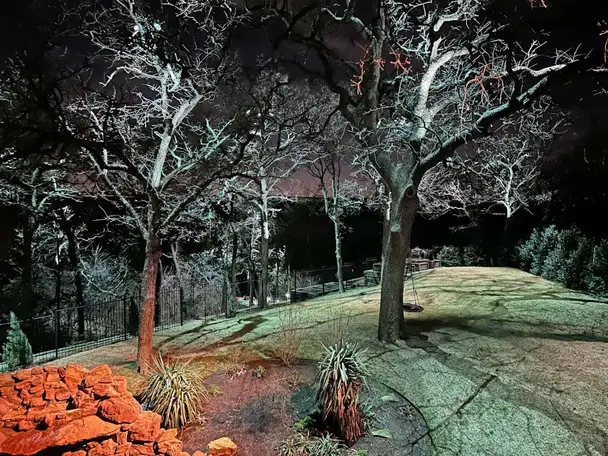
The photographs below are Corinth properties rather than stock imagery, and they are a reasonable cross-section of what the work looks like here: ordinary suburban lots with decent trees, a mix of brick and stone elevations, and gardens with more depth at the back than the frontage suggests.
The common thread, and the thing worth looking for, is restraint. In every one there is substantially more unlit than lit. That is not economy — it is the mechanism by which the lit parts read as lit. Your eye judges brightness by comparison, so a tree uplit against a black garden looks brilliant while the same tree uplit in a garden where everything else is also lit looks ordinary. The most common fault in schemes we are asked to take over is simply too many fixtures doing too little each.
The second thing to look for is that you cannot see the fixtures. In a photograph taken at the aiming height of an eye, any visible lamp is a lamp somebody will see from a window or a footpath. Behind planting, under an eave, in an in-grade housing or outside the frame is where they belong. If you are weighing quotes, the buyer's guide sets out what else separates a designed scheme from a priced fixture list.
Photographed After Dark in Corinth
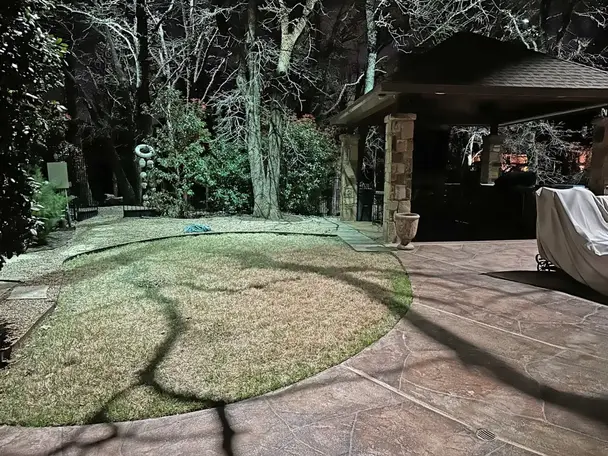
Seven Corinth properties, photographed after dark on the night each system was set. Every one is a TC Lighting installation, shot on the property at night — no stock imagery and no renderings. Click any of them to see it full screen.


What Clients Have Written
No Corinth client has written to us yet, so rather than dress a letter from somewhere else up as a local one, here are three from elsewhere in the service area with the towns they were written from. All thirty-one are on the reviews page in full.
“Our home had 15 year old exterior lighting, some was working, some not, many old rusted boxes and broken fixtures. Todd came over, worked up a design plan, nothing over the top and then transformed our house, trees, courtyard and creek area into a warm and natural looking environment…”
“I'm so pleased with the landscape lighting recommendation. Todd and his team did an amazing job on our lighting! Thank you again. Khurrum and I really appreciate it.”
Corinth, TX — and How Far It Is From Us
Denton County, between Lewisville Lake and Lake Dallas, about eighteen miles north of Carrollton. Free on-site design visit, and Todd comes out himself.
Corinth, TX · inside the TC Lighting service area · free on-site design visit
All Eight Services, Available in Corinth
Landscape lighting is the bulk of the work, but it is not all of it. Every service below is available on a Corinth property, from the same crew and the same licensed Texas electrical contractor.
Landscape Lighting
Design and installation — uplighting, moonlighting, path and specimen work.
Read more →Holiday Lighting
Seasonal install, maintained through the season, taken down and stored.
Read more →Permanent Festive LED
Govee-type colour-changing track set into the eave line. Invisible by day.
Read more →LED Conversion & Retrofit
Halogen to LED on an existing system, keeping the runs and fixtures worth keeping.
Read more →Pole, Site & Hardscape
Car parks, drives, steps, walls and seating areas, residential and commercial.
Read more →Interior Lighting
Inside work from the same licensed electrical contractor.
Read more →Ring Camera Installation
Cameras and doorbells fitted and wired properly.
Read more →Repair & Maintenance
Diagnosing and rebuilding failing systems, including ones we did not install.
Read more →Or start here: the home page for the whole picture, about Todd Cormier for who turns up, the photo gallery for the work itself, reviews for what clients say, and contact to reach us directly.
Corinth Landscape Lighting Questions
Yes. The seven photographs on this page are all Corinth properties, shot after dark on the night each system was set, and Denton County is one of the five counties TC Lighting covers.
It usually means those fixtures are over-powered, too wide or aimed slightly off, so a lot of their output is travelling through air instead of landing on a surface. Moist air simply makes that visible. A tight beam landing cleanly on a trunk or wall has little spare light to scatter and looks the same wet or dry.
Often not as far as people assume. The land immediately around Lewisville Lake and Lake Dallas is Corps of Engineers land rather than part of the lot, and we do not install fixtures or run cable beyond that boundary. Your survey or plat settles where it is, and we would rather look at that than guess.
The opposite. Your eye adapts to the darkest thing in view, so against unlit Corps land a modest scheme reads as generous and gains real depth. Properties on that edge usually run noticeably lower in output than an equivalent lot in the middle of town, and look better for it.
A typical lot here is one to two days on site plus a separate evening for the night-set, which is when the fixtures are actually aimed. On lakeside properties we try to do that aiming on a still night, because still damp air is the condition that shows up any fixture that is not quite right.
Where Else Todd Works Near Corinth
- Landscape lighting in Lewisville
- Landscape lighting in Denton
- Landscape lighting in Flower Mound
- Landscape lighting in Frisco
- What the work involves, in detail — design, conduit, day-set and night-set.
- Repair and maintenance, including systems somebody else installed.
Ask Todd About Your Corinth Property
Four fields, about fifteen seconds. Send the address and what you are hoping to light. Todd walks the property himself, in daylight, and you get a written plan with a fixed price and dates before any work begins.
- Free, no-obligation design visit and written plan
- Licensed Texas Electrical Contractor — TECL 41495
- Conduit-protected wiring and daily site cleanup
- Every fixture day-set, and a night-set on most projects
Prefer to talk? Call (972) 345-1180.