Licensed Texas Electrical Contractor · TECL 41495 ★ 4.9 / 5 · 40 Google Reviews ★ 5.0 / 5 · 40 Angi Reviews 40+ Years in the Lighting Industry TC Lighting, LLC Serving DFW Since 2017 BBB Accredited Moonlighting & Downlighting Specialists Free On-Site Design Visit & Written Plan LED Conversion & Retrofit Holiday & Permanent Festive LED — Booking Now Residential & Commercial Line Voltage & Low Voltage
4.9 ★Google · 40 Reviews
5.0 ★Angi · 40 Reviews
40+Years in Lighting
2017Serving DFW Since
★★★★★

“Todd instinctively knew what I wanted and what I needed… The team went above and beyond. Bonus — the price is reasonable.”

— Margaret Chabris · Dallas, TX

McKinney has been the seat of Collin County since 1848, when the legislature named it for Collin McKinney, and the 1927 courthouse still stands on the square. The railroad arrived in 1872, and the streets laid out around the square in the decades after it are the oldest residential fabric in the county.

Those streets come with something that cannot be bought: trees planted a hundred years ago, now very large, standing over narrow lots and in some places over brick paving that is nearly as old. They are the best feature of a historic McKinney property and the reason the installation takes longer here than it does three miles east. Because the other half of McKinney — everything built out toward the tollway in the last fifteen years — is a completely different job, and this page covers both honestly.

Roots

You Do Not Trench Through a Hundred-Year-Old Root Plate, You Go Around It

A mature pecan or live oak on an old McKinney street has a root system that extends well past the edge of its canopy, and the fine feeder roots that keep it alive are mostly in the top eighteen inches of soil — exactly where a cable trench wants to go. Cut enough of them and the tree does not die that season; it declines over three or four, which is worse, because by then nobody connects the two events.

So on these properties the cable route is designed before the lighting is. In practice that means a few specific habits:

  • Route outside the drip line wherever the design allows, even when it means a longer run. Cable is cheap. The tree is not replaceable.
  • Where the route must cross root zone, the cable goes in by hand — a narrow slit cut with a spade, or an air-spade where the tree warrants it — not behind a trencher. Anything thicker than a thumb gets gone round, not through.
  • Nothing gets fixed to the tree. No screws, no straps, no ties. Fixtures that light a canopy from within are mounted on their own supports, and anything strapped to a trunk is removed at the next visit before it girdles.

Brick paving brings the same thinking. Old brick streets and walks can be lifted and relaid by hand and often look untouched afterwards, but they cannot be cut and they cannot be bored through casually, so a crossing is planned on paper first. This is slower than a modern lot. It is also why these properties still have their trees.

The Old Streets

What a Hundred-Year Canopy Lets You Do That a New Lot Cannot

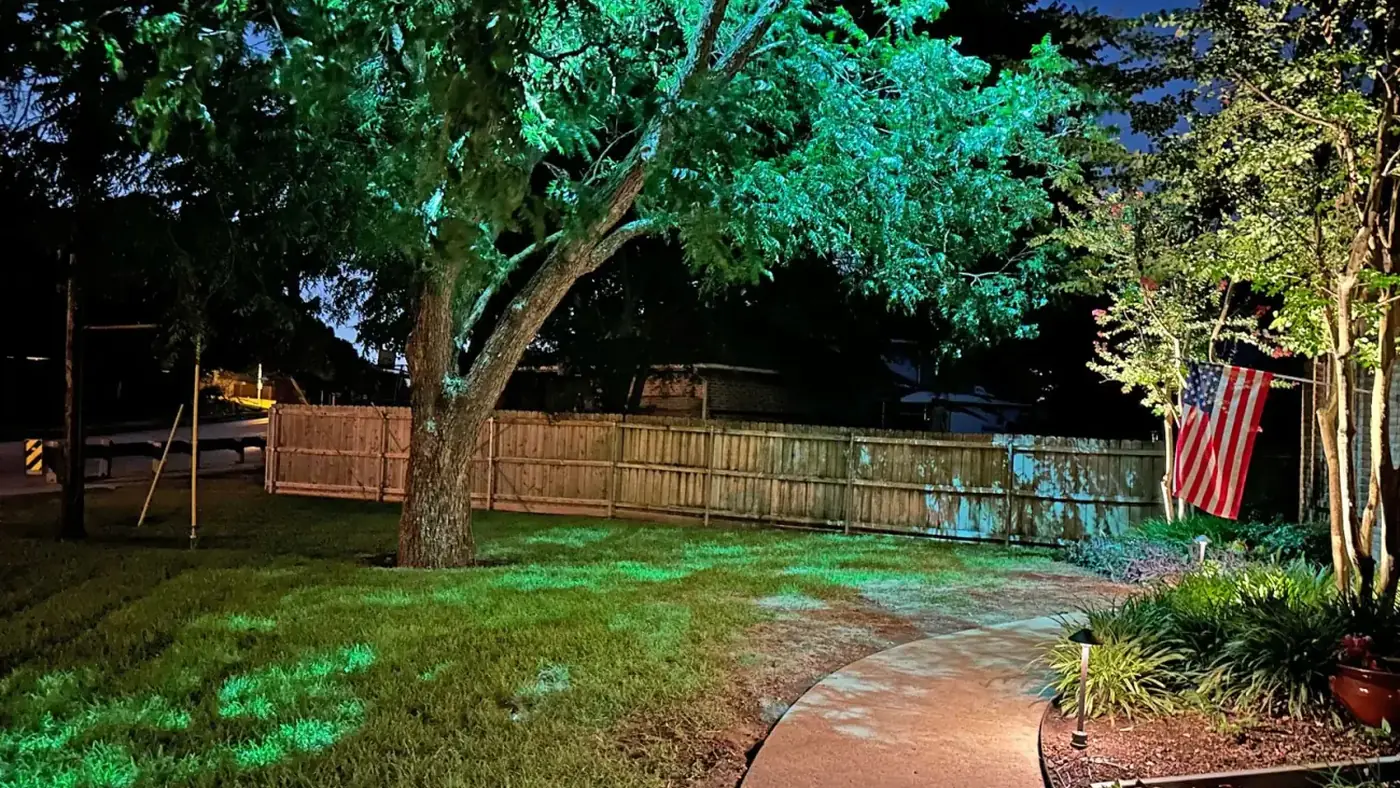
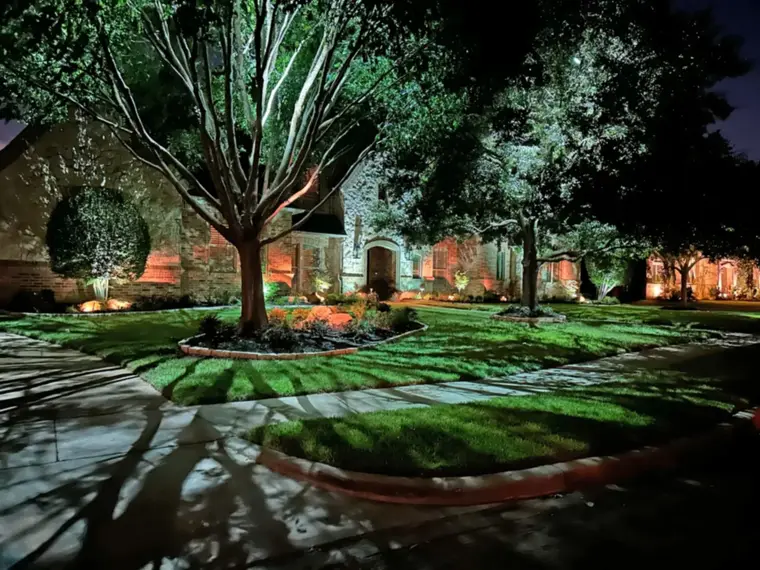
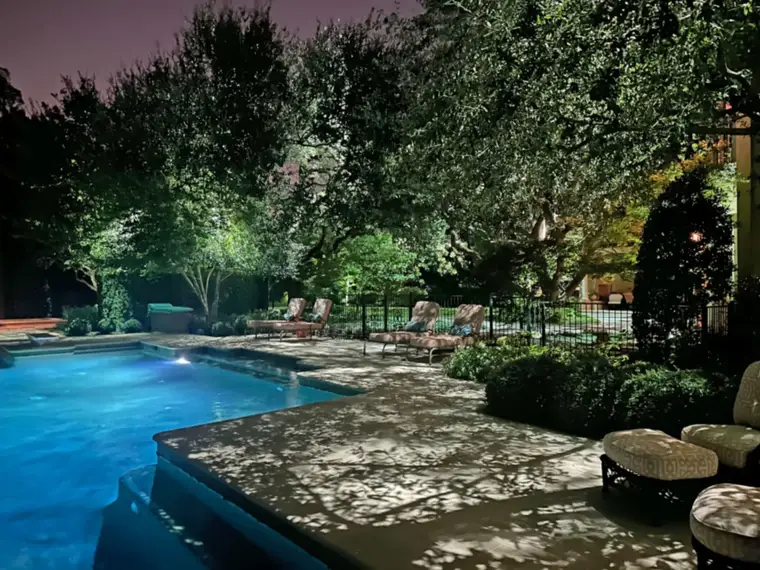
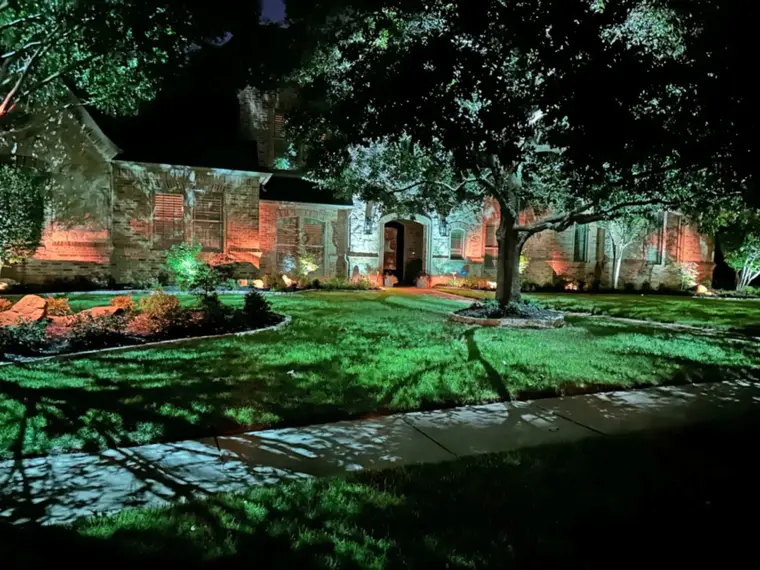
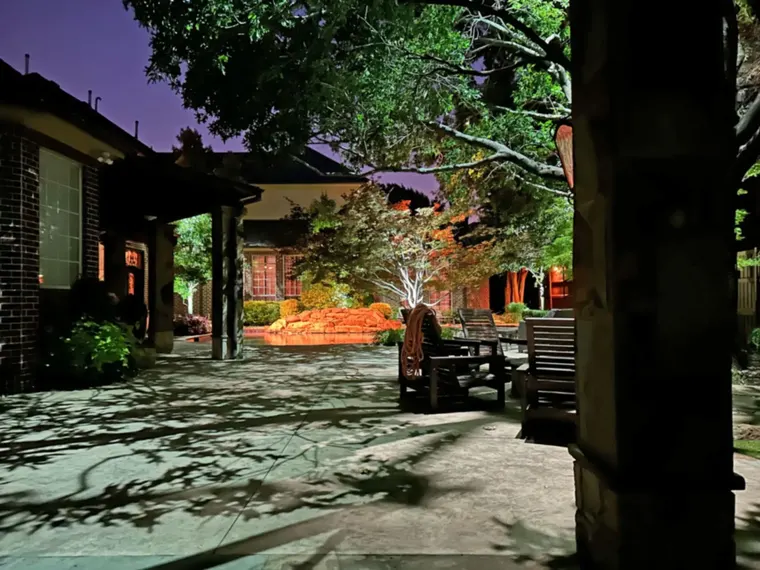
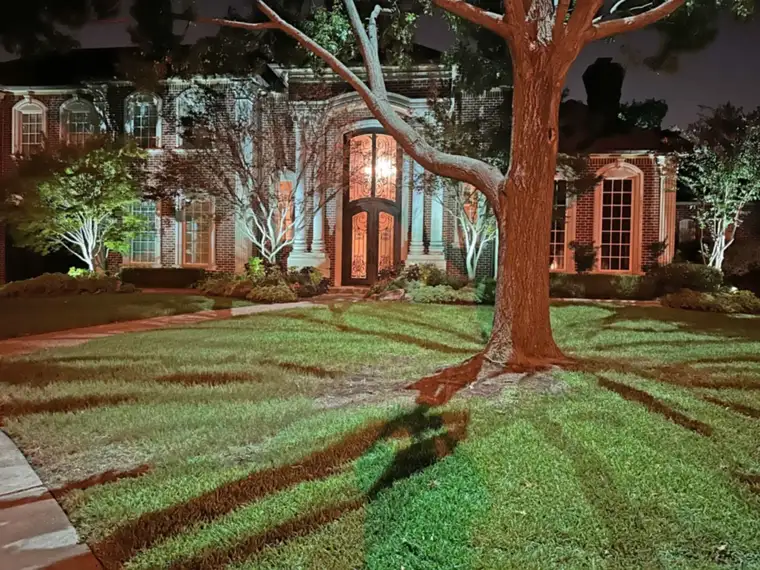
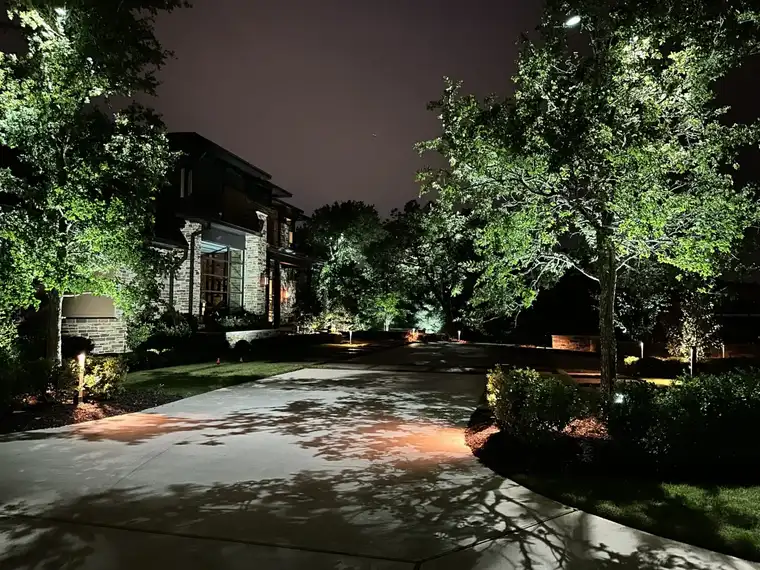
The compensation for all that care is the best effect in landscape lighting, and it is only available where the trees are old enough. A fixture mounted high in a mature canopy, aimed down through the branches, throws the shadow pattern of the leaves across the lawn and the house below. It does not read as a light. It reads as moonlight, and on a street of hundred-year-old trees you can do it from several directions at once so the shadows overlap the way they do on a real bright night.

What this needs is height and a dense enough canopy to make a pattern, which is why it cannot be faked on a new lot and why a historic McKinney street is worth lighting from above rather than only from the ground. It is also the most forgiving effect there is: because the source is far away and shielded, there is almost no glare at eye level, and the whole garden gets a soft general light that no amount of ground-level uplighting reproduces.

The constraint is access and safety. Working at height in a mature tree is proper climbing work, and the fixture, its mount and its cable all have to allow for a trunk that will keep growing. That is the part done properly or not at all.

East McKinney

Half the City Was Built in the Last Fifteen Years, and It Is a Different Brief

It would be misleading to write a McKinney page entirely about the historic streets. Most of the city's houses are newer than most of its residents, built out toward the tollway and US 380 since the 2010s, and the lighting brief there has nothing to do with roots or brick.

On a newer McKinney lot the questions are the ones that come with recent construction: getting the conduit in before the hard landscaping is finished where that is still possible, a transformer with enough headroom that the back garden can be added later without replacing it, and lighting a tall, repeated builder elevation so it reads as a designed house rather than as one of six. Those are covered in detail on the Frisco page and the Allen page, and the same approach applies here.

The practical point is that the first question at the design visit is which McKinney you are in, because the answer changes the plan, the install method and the price. Todd makes that visit himself, in daylight, and it is free.

What Clients Say

What Clients Have Written

No McKinney client has written to us yet, so rather than dress a letter from somewhere else up as a local one, here are three from elsewhere in the service area with the towns they were written from. All thirty-one are on the reviews page in full.

”
★★★★★

“TC Lighting was highly recommended to us for a new home we recently built, and we could not be more pleased with the outcome. Over the course of a just few weeks, Todd both developed and executed his vision of a unique landscape lighting design for our property, given the existing trees, landscaping and topography…”

BT
B. Thomas
Flower Mound, TX
Client Letter
”
★★★★★

“The work and design you did are excellent. The lighting around our yard highlights the exterior of our home and gives a pleasant, subtle ambiance outside to enjoy after dark. We use our backyard and pool much more than before the lights were installed…”

SC
Stephen Cavender
Dallas, Texas
Client Letter
”
★★★★★

“Todd has a talent for outdoor lighting. He has honed his craft for many years and takes pride in creating a masterpiece of art using outdoor lighting. Look at his portfolio of work and you will see creativity and art in each project. He is honest and trustworthy…”

PH
Paul Hermann
Dallas, TX
Client Letter

Read all thirty-one client letters →

Where This Is

McKinney, TX — and How Far It Is From Us

Collin County seat, at the top of US 75, about thirty miles north-east of Carrollton. Free on-site design visit, and Todd comes out himself.

McKinney, TX · inside the TC Lighting service area · free on-site design visit

Common Questions

McKinney Landscape Lighting Questions

We have very old trees. Will running cable damage them?

Not if the route is designed around them. Fine feeder roots sit in the top eighteen inches of soil, which is exactly where a trench goes, so we route outside the drip line wherever the design allows and hand-cut a narrow slit where we have to cross. Anything thicker than a thumb is gone round rather than cut.

Can you put lights up in our trees?

Yes, and on a mature McKinney canopy it is the best effect available -- a fixture high in the branches aimed down throws the leaf shadow across the lawn and reads as moonlight rather than as a light. Nothing is screwed or strapped to the tree; fixtures go on their own mounts, allowing for a trunk that keeps growing.

Our street has original brick paving. Can a cable cross it?

Usually yes. Old brick can be lifted by hand and relaid so it looks untouched, but it cannot be cut or casually bored, so the crossing is planned on paper before anyone starts. It is slower than a modern lot and we price it that way rather than discovering it on the day.

We are in a newer part of McKinney. Is any of this relevant?

Honestly, not much of it. On a newer lot the questions are conduit before the hard landscaping is finished, a transformer with headroom for the back garden later, and lighting a repeated builder elevation so it reads as its own house. The first thing we establish at the visit is which McKinney you are in.

Is our house inside a historic district?

That is worth establishing before anything is fixed to the building, and it is a question for the city rather than for us. We bring a written plan showing exactly what goes where and what attaches to the house, which is the document a reviewer will want. Confirm current requirements for your address with the City of McKinney.

Nearby

Where Else Todd Works Near McKinney

Free On-Site Design Visit

Ask Todd About Your McKinney Property

Four fields, about fifteen seconds. Send the address and what you are hoping to light. Todd walks the property himself, in daylight, and you get a written plan with a fixed price and dates before any work begins.

  • Free, no-obligation design visit and written plan
  • Licensed Texas Electrical Contractor — TECL 41495
  • Conduit-protected wiring and daily site cleanup
  • Every fixture day-set, and a night-set on most projects

Prefer to talk? Call (972) 345-1180.

Request Your Free Design Visit

See What Your Property Looks Like After Dark

Free on-site design visit anywhere in Dallas–Fort Worth. You will talk to Todd, not a call center.

(972) 345-1180
Licensed Texas Electrical Contractor TECL 41495 · Free Design Visits
Book My Free Design Visit
(972) 345-1180
Landscape Lighting · Dallas–Fort Worth Metroplex
Free Design Visit