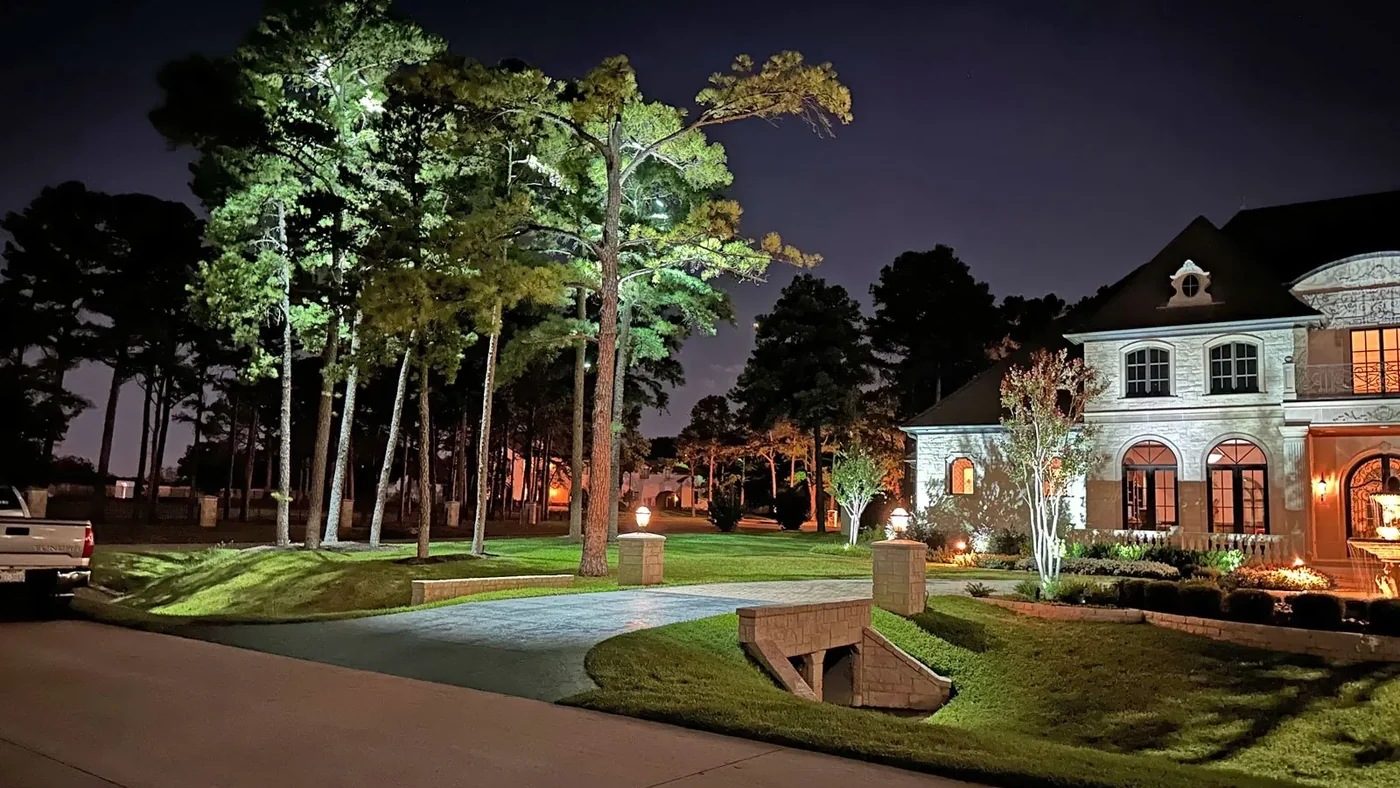
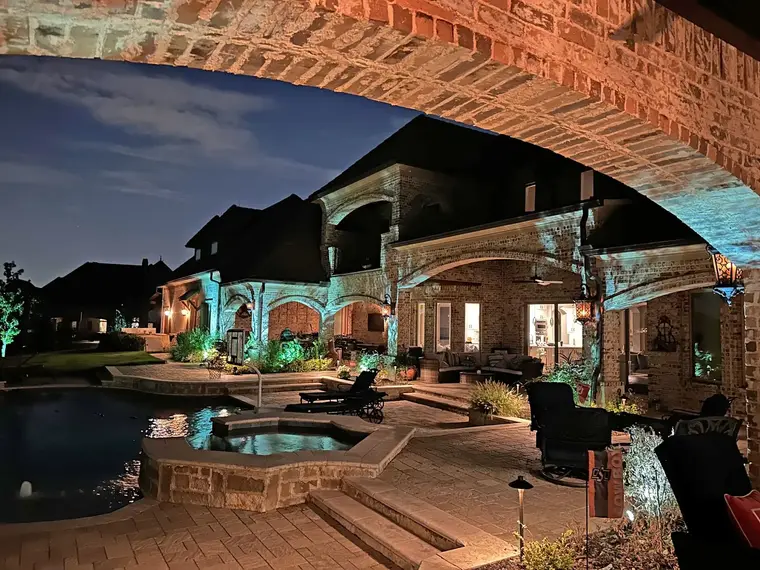
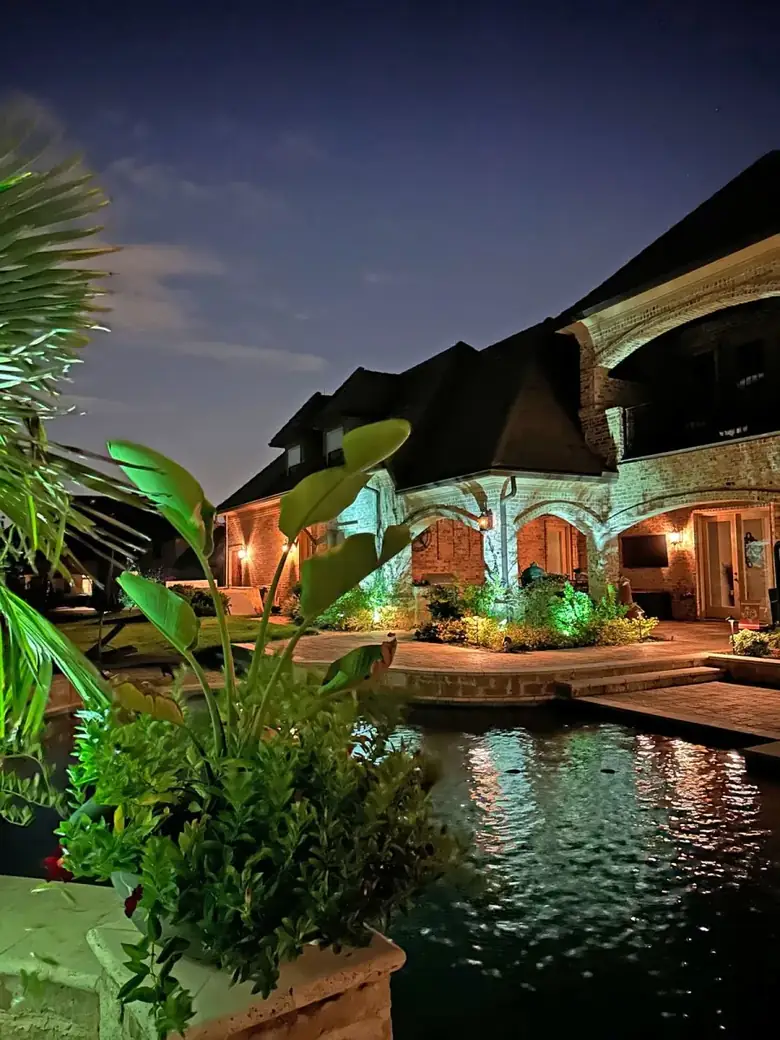
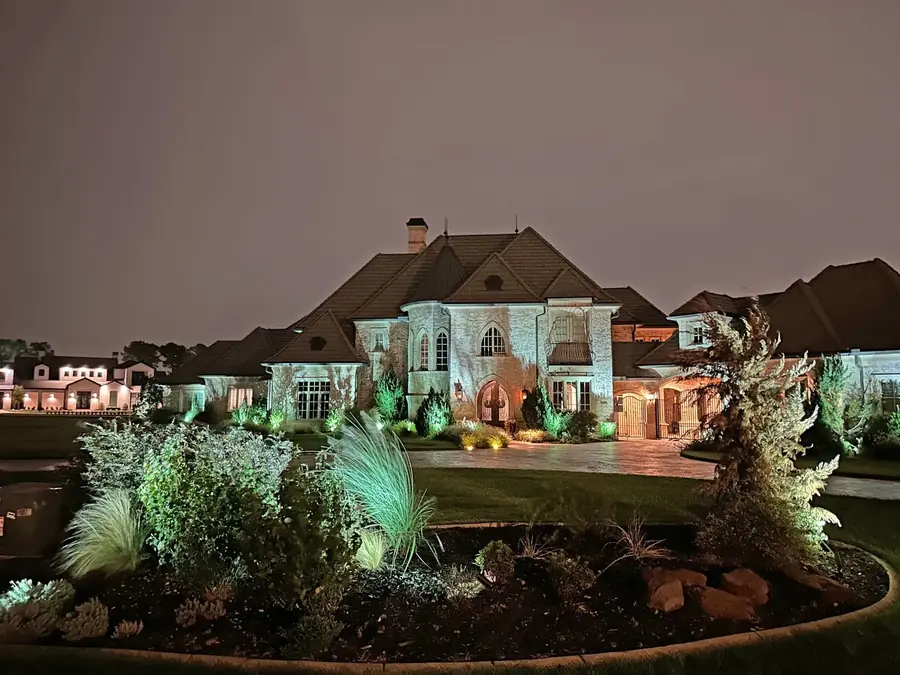
Licensed Texas Electrical Contractor · TECL 41495 ★ 4.9 / 5 · 40 Google Reviews ★ 5.0 / 5 · 40 Angi Reviews 40+ Years in the Lighting Industry TC Lighting, LLC Serving DFW Since 2017 BBB Accredited Moonlighting & Downlighting Specialists Free On-Site Design Visit & Written Plan LED Conversion & Retrofit Holiday & Permanent Festive LED — Booking Now Residential & Commercial Line Voltage & Low Voltage
4.9 ★Google · 40 Reviews
5.0 ★Angi · 40 Reviews
40+Years in Lighting
2017Serving DFW Since
★★★★★

“Todd instinctively knew what I wanted and what I needed… The team went above and beyond. Bonus — the price is reasonable.”

— Margaret Chabris · Dallas, TX

Rowlett is an unusual shape for a Texas suburb. Lake Ray Hubbard borders it on the east, the south and the west, and the city runs out into the water in a series of long fingers — roughly thirty miles of shoreline for a city you can drive across in fifteen minutes.

That geometry is the whole story for lighting here. It puts a very large number of houses within a few hundred feet of open water, which means two things almost no inland lot has to think about: an uninterrupted wind that arrives off a mile of open surface, and a dark far side that is being looked at from, as well as toward. Both are solvable. Neither is solved by the same fixture set you would put on a flat lot in the middle of town.

Wind Off the Water

A Lake Breeze Finds Every Fixture That Was Only Pushed Into the Ground

Most landscape fixtures ship with a plastic or metal spike, and on a sheltered lot that spike is adequate for years. On a Rowlett waterfront lot it is not, and the failure is gradual enough that people blame the fixture rather than the mounting.

What happens is this. Wind pushes on the fixture head, which is on a lever arm a foot or more above the ground. That load works the spike back and forth in the soil. The hole it sits in gets slightly wider every week. Nothing breaks and nothing stops working — the beam simply walks off its target, a degree or two at a time, until the uplight that was grazing a chimney is pointed at a bedroom window and the one that lit a trunk is lighting lawn.

The answers are not exotic. A fixture that matters goes on a sleeved riser set in a small concrete puck below grade, or is mounted to structure — a wall, a pier, a retaining wall cap — rather than to soil. Heads get a locking knuckle rather than a friction one. Where a spike is genuinely the right call, it is a long one, driven into undisturbed ground rather than into the soft, often imported bed that the landscaper laid. We decide that fixture by fixture on the exposed side of the property, which is the side facing the water.

Facing a Cove

On a Rowlett Lot, Someone Is Looking Back at You

An ordinary garden is seen from inside the house and from the street. A lot on one of Rowlett's fingers is also seen from across the water — from the houses on the opposite shore, from the park on the far point, and from anyone out on the lake. That sounds like a nice problem. It is mostly a discipline.

Water does not absorb stray light, it carries it. A fixture aimed even slightly outward over the cove does not illuminate anything, because there is nothing out there to catch it; it just becomes a bright point visible for half a mile, and at the distances involved a single badly aimed uplight is more conspicuous than a whole garden lit properly. The rule we work to is that nothing on the water side aims outward. Light goes back at the house, down at the ground, or into a tree — never across the surface.

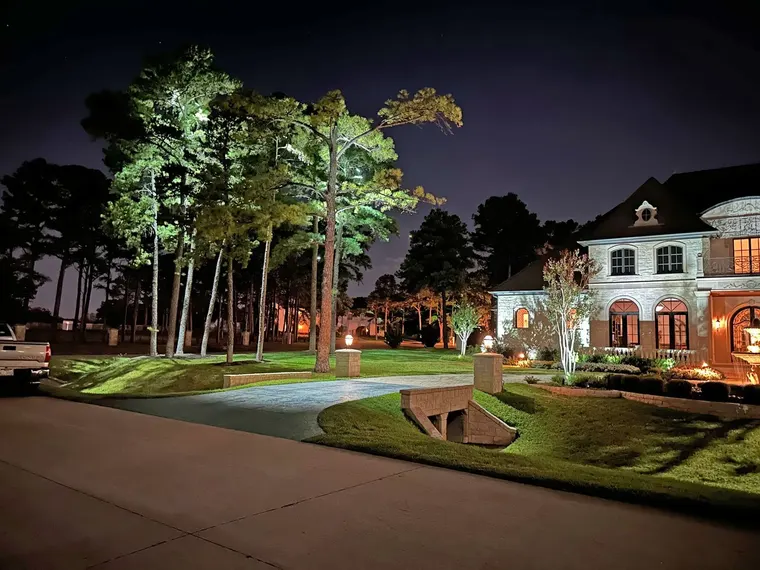
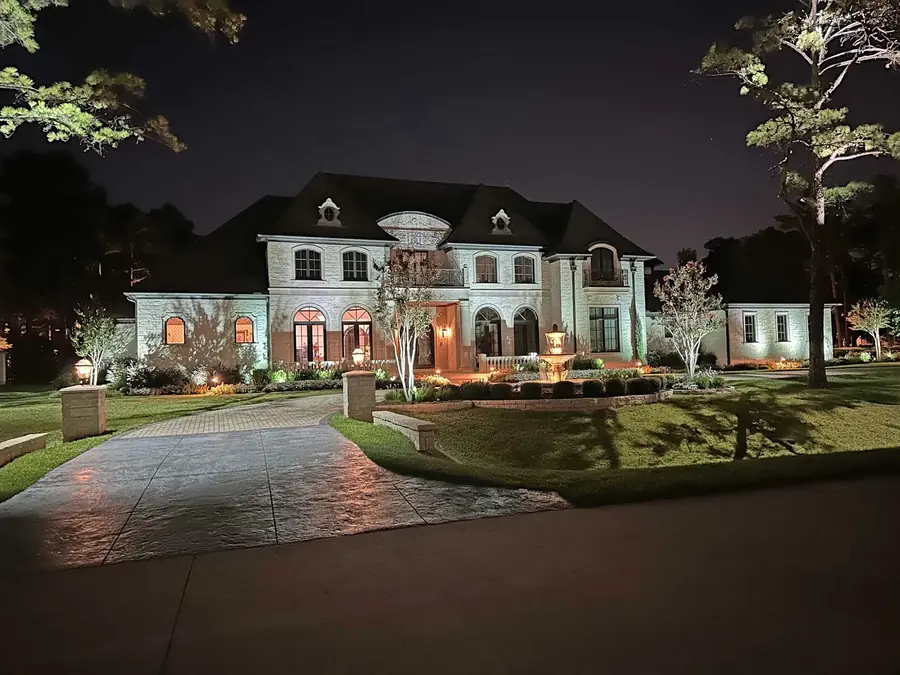
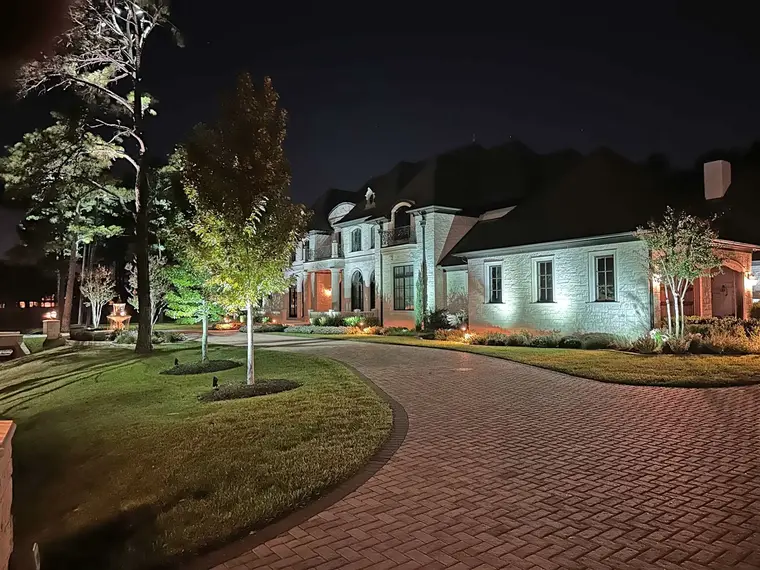
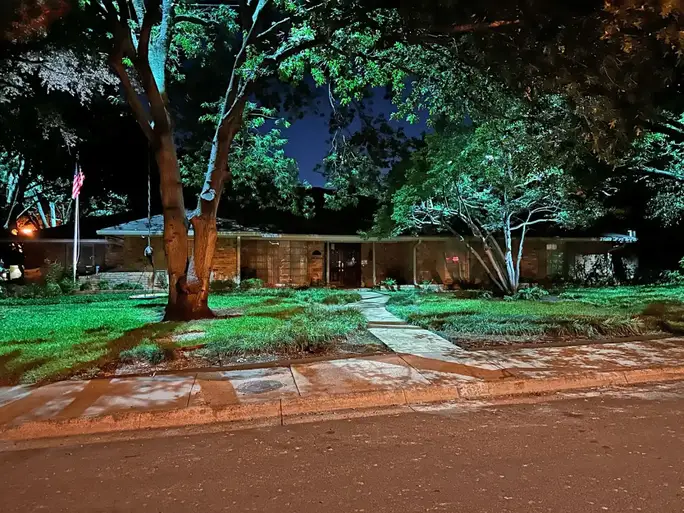
The payoff is the opposite of a sacrifice. A lit near ground with a black lake behind it has enormous depth, and the house reads cleanly from the far shore because it is the only lit thing in the frame rather than one glare source among several. If you want to know what that restraint looks like applied to an acre, the Colleyville page goes through the same decision on a bigger property.

Where the Lawn Stops

Bulkheads, Steps Down and the Last Twenty Feet

Nearly every waterfront lot in Rowlett ends in something built — a bulkhead, a riprap slope, a run of retaining wall, often a flight of steps down to a dock. That last twenty feet is where the lighting stops being decorative and starts being about not falling in.

  • Steps get lit for the tread, not the view. Low-level light from the side or from under a nosing, so the edge of each step is legible. An uplight at the bottom of a flight throws the treads into shadow and is worse than nothing.
  • The bulkhead cap is the mounting line. It is structure, it is already there, and a fixture fixed to it does not move in wind or wash out in the soft ground behind it.
  • Everything in that zone is specified for wet. Fittings, the gland where cable enters, and the connection method itself. Splashed and submerged are different ratings and we do not treat them as one.

Dock lighting proper is a separate conversation, because what may be fixed to a dock and what power may be taken out to one are governed by more than our preference — confirm the current requirements for your address and your dock permit with the city. The hardscape and site lighting page covers how the retaining wall and step work is built.

What Clients Say

What Clients Have Written

No Rowlett client has written to us yet, so rather than dress a letter from somewhere else up as a local one, here are three from elsewhere in the service area with the towns they were written from. All thirty-one are on the reviews page in full.

”
★★★★★

“The work and design you did are excellent. The lighting around our yard highlights the exterior of our home and gives a pleasant, subtle ambiance outside to enjoy after dark. We use our backyard and pool much more than before the lights were installed…”

SC
Stephen Cavender
Dallas, Texas
Client Letter
”
★★★★★

“I met Augustine at a QT gas station and I asked him about TC's work. I called Todd and he and Augustine sold me on their project. Now that it's done, my home has the best lights in the area, hands down. I'm very pleased with the workmanship and skill level and highly recommend them.”

EL
Edward Lopez
Dallas, Texas
Client Letter
”
★★★★★

“We have had landscape lighting on our property for many years and I have always done minor DIY repairs of lighting issues. When I had some recurring problems I could not resolve, I called a landscape lighting supplier I have used for years and was referred to Todd Cormier of TC Lighting…”

RC
Richard and Cindy Ceen
Dallas, Texas
Client Letter

Read all thirty-one client letters →

Where This Is

Rowlett, TX — and How Far It Is From Us

Dallas County, on Lake Ray Hubbard, about twenty-five miles east of Carrollton. Free on-site design visit, and Todd comes out himself.

Rowlett, TX · inside the TC Lighting service area · free on-site design visit

Common Questions

Rowlett Landscape Lighting Questions

Why do my lights keep ending up pointed in the wrong direction?

On a lot near the lake that is almost always the mounting rather than the fixture. Wind works a ground spike loose a little at a time, the hole widens, and the beam walks off target without anything actually breaking. Fixtures on the exposed side want a sleeved riser set below grade, or mounting to structure such as a wall or bulkhead cap.

Can you light the view out over the water?

We can, and we will advise against it. There is nothing out on the cove for the light to land on, so all an outward-aimed fixture does is make a bright point visible from the opposite shore. Lighting the near ground and leaving the water black gives far more depth and reads better from across the water, not less.

We have steps down to a dock. Can those be lit?

Yes, and they should be. Steps get low-level light from the side or under the nosing so each tread edge is legible, never an uplight at the bottom of the flight, which throws the treads into shadow. Fittings and connections in that zone are specified for wet rather than for damp.

Is the lake hard on equipment?

Ray Hubbard is fresh water, so there is no salt corrosion to design around. What it does give you is constant wind and higher humidity, which punish poor mounting and poor connections rather than the fixtures themselves. That is why the mounting detail gets more attention here than it would five miles inland.

How far out do you come? Rowlett is on the far side of the county.

It is about twenty-five miles east of our base in Carrollton and well inside the area Todd covers himself. Send the address through the form and he will walk the property in daylight, free, and leave you with a written plan and a fixed price.

Nearby

Where Else Todd Works Near Rowlett

Free On-Site Design Visit

Ask Todd About Your Rowlett Property

Four fields, about fifteen seconds. Send the address and what you are hoping to light. Todd walks the property himself, in daylight, and you get a written plan with a fixed price and dates before any work begins.

  • Free, no-obligation design visit and written plan
  • Licensed Texas Electrical Contractor — TECL 41495
  • Conduit-protected wiring and daily site cleanup
  • Every fixture day-set, and a night-set on most projects

Prefer to talk? Call (972) 345-1180.

Request Your Free Design Visit

See What Your Property Looks Like After Dark

Free on-site design visit anywhere in Dallas–Fort Worth. You will talk to Todd, not a call center.

(972) 345-1180
Licensed Texas Electrical Contractor TECL 41495 · Free Design Visits
Book My Free Design Visit
(972) 345-1180
Landscape Lighting · Dallas–Fort Worth Metroplex
Free Design Visit