“We have worked with Todd for more than 20 years (three different homes), and have found his design and services to be the utmost in quality, creative, dependable and customer service focused. The outcome achieved by his mastery of outdoor lighting is spectacular, and we highly recommend him!”

Landscape Lighting in Lewisville, TX — Low Ground, Wet Ground and the Connections That Survive It
Below a dam, on a river bottom, where the thing that kills a lighting system is underneath it.
Lewisville sits on the Elm Fork of the Trinity, below the dam that made Lewisville Lake. Building that dam in the 1950s meant moving the town; the original settlement at Old Hall was abandoned and what is now called Old Town grew in its place. The 1885 building that houses the community theatre is the oldest structure still standing.
The geography left behind is the point. A good deal of Lewisville is river bottom: low, flat, slow-draining ground that holds water after rain in a way the sandy ridges a few miles west never do. For a landscape lighting system, the enemy here is not the sun, the clay or the trees. It is water sitting in the ground around your connections, and it is the single most common reason a system in this part of the county starts dropping fixtures in its third or fourth year.
The Joint Is Where These Systems Die, and It Dies Wet
A low-voltage system is cable, fixtures and joints. The cable almost never fails. The fixtures, if they are decent, last a long time. What fails is the connection between them, and on bottomland it fails by corrosion rather than by anything dramatic.
The mechanism is worth understanding because it tells you what to insist on. A joint made with a twist-on connector — a wire nut, even one sold as outdoor-rated — is not sealed; it is a cone of plastic over twisted copper. Buried in ground that stays damp for weeks at a time, moisture wicks in along the conductors. The copper oxidises, resistance climbs, that run dims slightly, and eventually the joint opens altogether. Nobody notices the dimming. They notice the fixture that went out, and by then several others are halfway there.
What we use instead on low ground is a sealed, gel-filled or heat-shrink connection, made so the copper never meets the water, and we keep joints out of the lowest points of the garden on principle — a connection that sits six inches higher is a connection that spends far less of its life submerged. Where a run has to cross genuinely wet ground it goes in conduit rather than direct-buried. None of this is expensive at install. All of it is expensive to retrofit, because retrofitting it means finding the joints again.
If You Back Onto LLELA, the Dark Is an Asset and a Responsibility
The Lewisville Lake Environmental Learning Area occupies the bottomland below the dam, where the Blackland Prairie runs into the dry upland forests of the Eastern Cross Timbers. Properties that back onto it, or onto the Corps land around the lake, have something unusual for a suburban lot: a boundary beyond which there is no light at all, and genuine wildlife moving through at night.
The design consequence is that you need far less light than you think. Your eye adapts to the darkest thing in the view, so against a black treeline a modest scheme reads as generous — and an ordinary suburban light level reads as a floodlit car park. We typically run properties on this boundary noticeably lower in output than an equivalent lot in the middle of town, and they look better for it, not worse.
The responsibility half is straightforward and we raise it because clients here usually care about it. Light spilling into a preserve is not neutral for the things living in it. Keeping beams aimed inward and steep, keeping colour warm, and putting the garden on a timer that turns it off at a sensible hour rather than running it to dawn costs you nothing and settles the question. It is also, incidentally, the configuration that uses the least electricity.
A Small Historic Lot Is Not a Big Job Scaled Down
Old Town Lewisville has small, square, tightly packed lots with houses near the street, and the schemes that work there are not reduced versions of an acre-lot plan. They are a different shape of plan.
On a large property you build depth: foreground, middle, a lit tree at the back, layers the eye travels through. On a forty-foot frontage there is no middle distance to build. Everything is close, which means every fixture is seen almost head-on by somebody on the footpath, and two things follow. Glare control stops being a refinement and becomes the first decision — shrouds, glare guards and honest-to-goodness hiding places matter more than output. And the frontage is the whole scheme, because on these lots the front garden is what the house has.
The good news is that a small Old Town lot done properly needs very few fixtures — often six or eight — and the cost reflects that. What it needs instead is care about where each one goes, which is a design problem rather than an equipment one. If the house is one of the older ones, the Denton page covers how period timber and deep porches want to be lit.
What This Looks Like on the Ground Near Lewisville
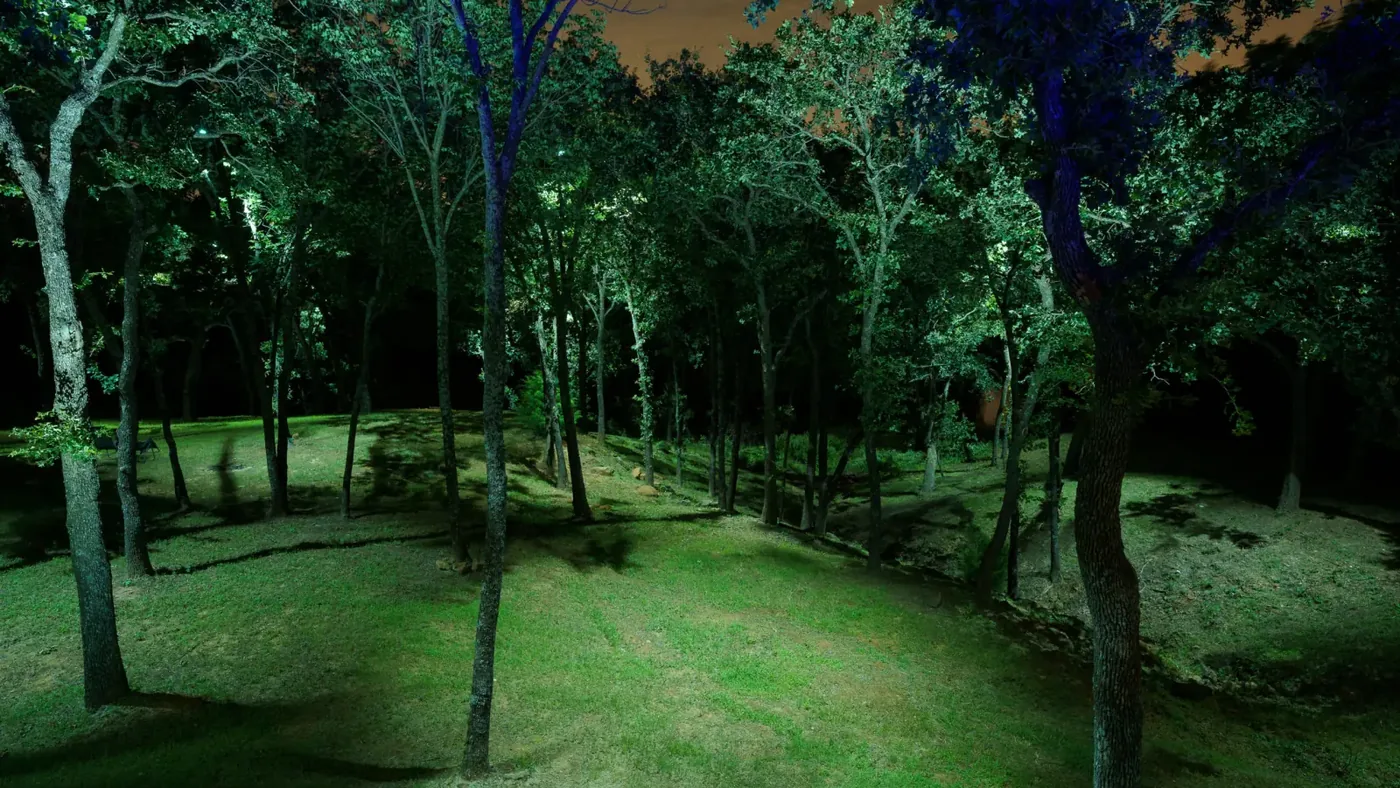
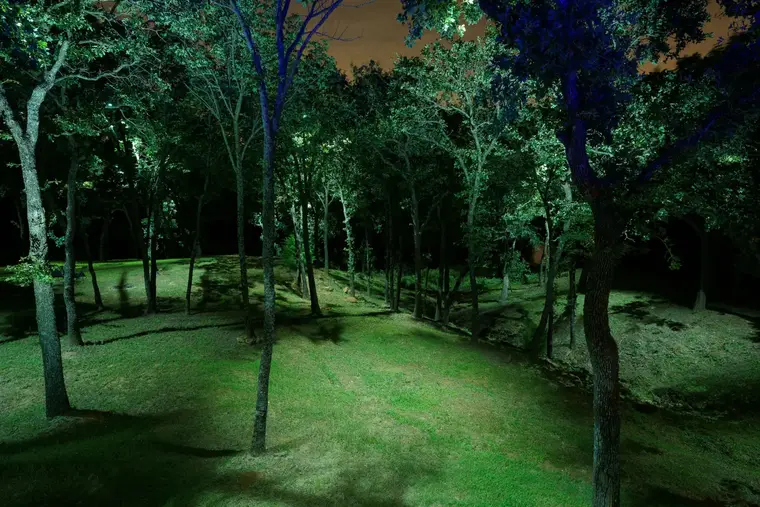
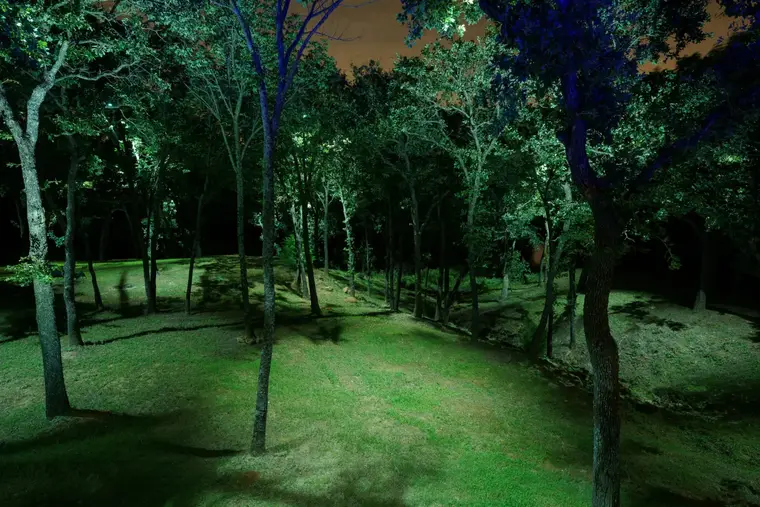
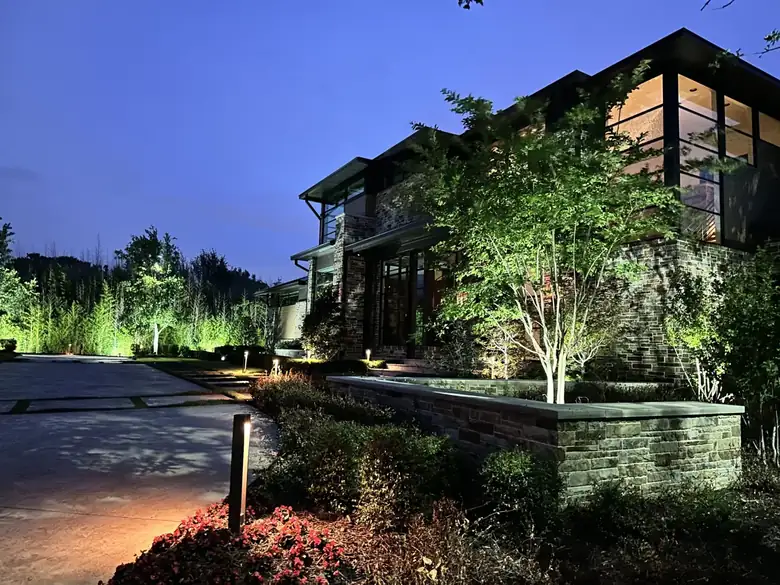
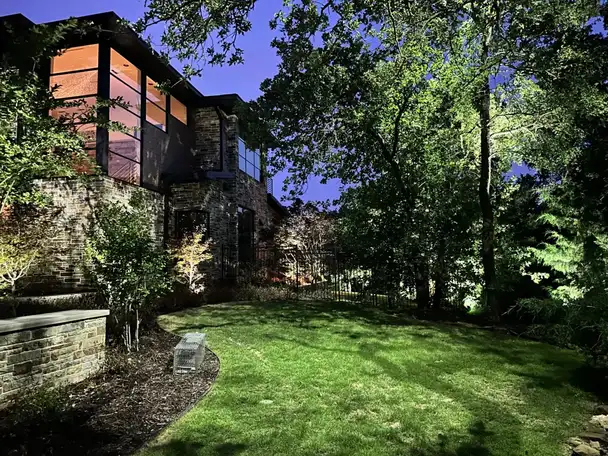
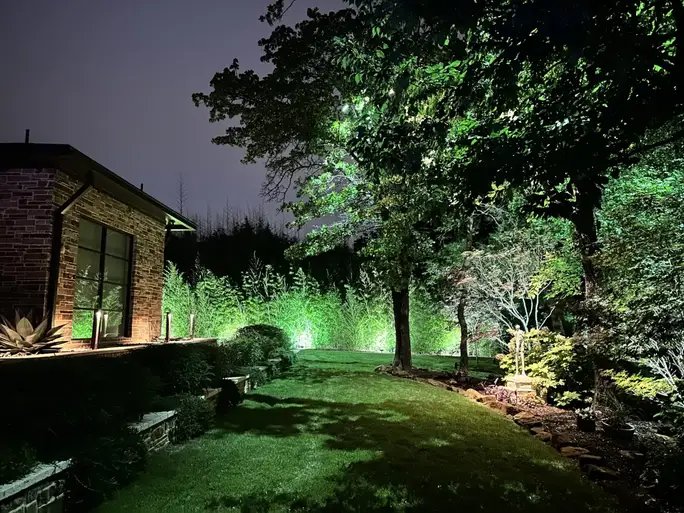
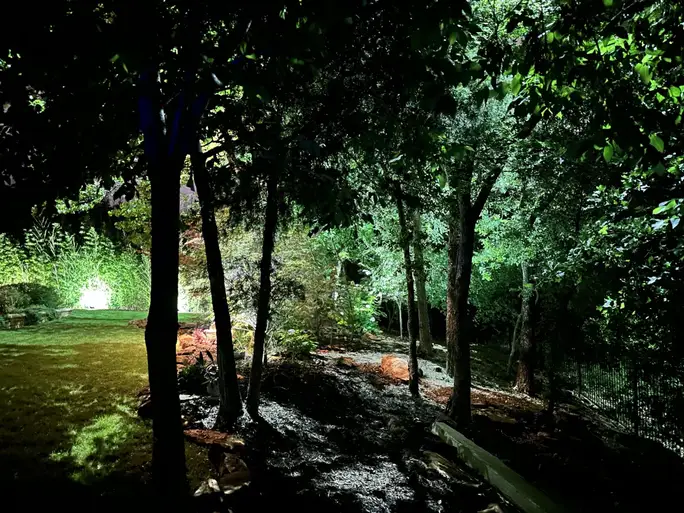
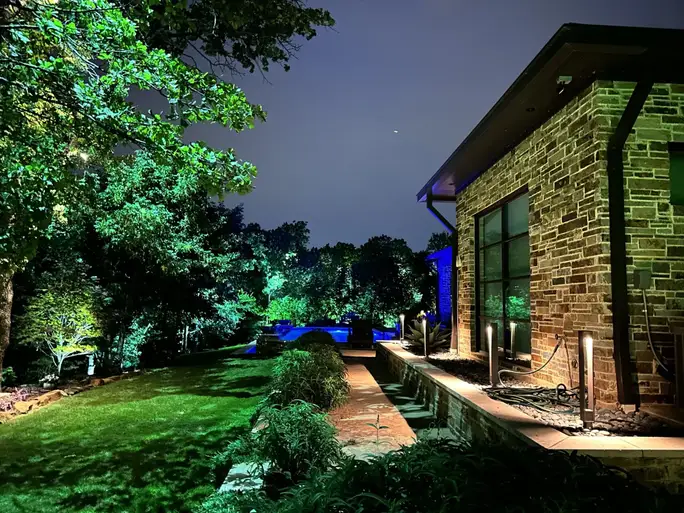
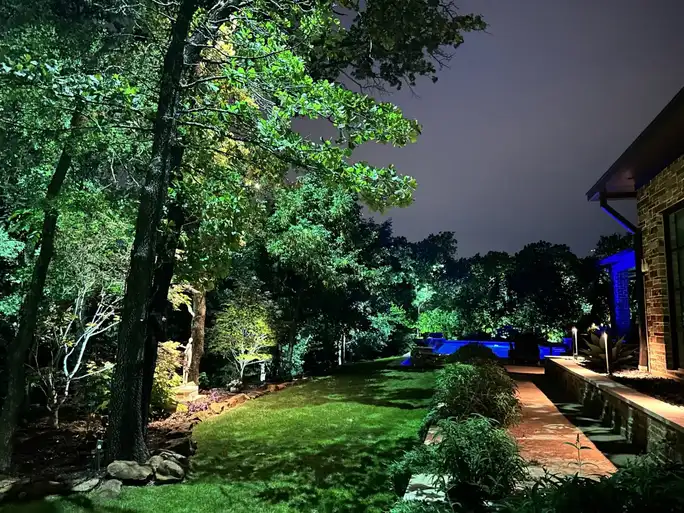
We have not photographed a Lewisville installation yet, so every photograph below is from Flower Mound — the nearest documented work, on the same ground and the same kind of property. Each one is captioned with the town it was actually taken in. All are TC Lighting installations, shot after dark on the property. Click any of them to see it full screen.


The full gallery is grouped by town, and the reviews page carries thirty-one client letters in full. If you are in Lewisville and want your property to be the first photograph on this page, the design visit is free.
What Clients Have Written
No Lewisville client has written to us yet, so rather than dress a letter from somewhere else up as a local one, here are three from elsewhere in the service area with the towns they were written from. All thirty-one are on the reviews page in full.
“Todd / TC Lighting was remarkably responsive. Quick to visit with me to create a vision for my backyard lighting. Todd instinctively knew what I wanted and what I needed. The crew did a terrific job in upgrading my lighting. The team went above and beyond. Bonus — the price is reasonable…”
“Wow! Todd with TC Lighting LLC delivered an absolutely amazing transformation to the nighttime profile of our home's curb appeal! From start to finish, Todd's professional approach and outstanding artistry imagination has really shone through…”
Lewisville, TX — and How Far It Is From Us
Denton County, on the Elm Fork below Lewisville Lake, about twelve miles north of Carrollton. Free on-site design visit, and Todd comes out himself.
Lewisville, TX · inside the TC Lighting service area · free on-site design visit
All Eight Services, Available in Lewisville
Landscape lighting is the bulk of the work, but it is not all of it. Every service below is available on a Lewisville property, from the same crew and the same licensed Texas electrical contractor.
Landscape Lighting
Design and installation — uplighting, moonlighting, path and specimen work.
Read more →Holiday Lighting
Seasonal install, maintained through the season, taken down and stored.
Read more →Permanent Festive LED
Govee-type colour-changing track set into the eave line. Invisible by day.
Read more →LED Conversion & Retrofit
Halogen to LED on an existing system, keeping the runs and fixtures worth keeping.
Read more →Pole, Site & Hardscape
Car parks, drives, steps, walls and seating areas, residential and commercial.
Read more →Interior Lighting
Inside work from the same licensed electrical contractor.
Read more →Ring Camera Installation
Cameras and doorbells fitted and wired properly.
Read more →Repair & Maintenance
Diagnosing and rebuilding failing systems, including ones we did not install.
Read more →Or start here: the home page for the whole picture, about Todd Cormier for who turns up, the photo gallery for the work itself, reviews for what clients say, and contact to reach us directly.
Lewisville Landscape Lighting Questions
On low ground that is nearly always corroded connections rather than failed fixtures. Moisture wicks into an unsealed joint, the copper oxidises, resistance climbs and the run dims before it opens altogether. The repair is to remake the joints sealed; the fixtures themselves are usually fine.
Sealed ones -- gel-filled or heat-shrink, made so the copper never meets water. Twist-on wire nuts are not sealed even when sold as outdoor-rated. We also keep joints out of the lowest points of a garden and run cable in conduit where it has to cross ground that stays wet.
Not if it is aimed inward and steep, kept warm in colour and put on a timer that turns off at a sensible hour rather than running to dawn. You also need far less output than a lot in the middle of town, because the eye adapts to the dark treeline -- a modest scheme reads as generous against it.
Yes, and it is usually one of the more affordable jobs we do, because a small frontage done properly needs six or eight fixtures rather than twenty. What it needs is care about placement and glare control, since on a short frontage every fixture is seen almost head-on from the footpath.
Mainly it dictates depth and route rather than anything exotic. Cable goes deep enough to survive a spade and is routed along the higher lines through a garden rather than the lowest. Where we cannot avoid a wet crossing it goes in conduit.
Where Else Todd Works Near Lewisville
- Landscape lighting in Flower Mound
- Landscape lighting in Corinth
- Landscape lighting in Denton
- Landscape lighting in Grapevine
- What the work involves, in detail — design, conduit, day-set and night-set.
- Repair and maintenance, including systems somebody else installed.
Ask Todd About Your Lewisville Property
Four fields, about fifteen seconds. Send the address and what you are hoping to light. Todd walks the property himself, in daylight, and you get a written plan with a fixed price and dates before any work begins.
- Free, no-obligation design visit and written plan
- Licensed Texas Electrical Contractor — TECL 41495
- Conduit-protected wiring and daily site cleanup
- Every fixture day-set, and a night-set on most projects
Prefer to talk? Call (972) 345-1180.