Licensed Texas Electrical Contractor · TECL 41495 ★ 4.9 / 5 · 40 Google Reviews ★ 5.0 / 5 · 40 Angi Reviews 40+ Years in the Lighting Industry TC Lighting, LLC Serving DFW Since 2017 BBB Accredited Moonlighting & Downlighting Specialists Free On-Site Design Visit & Written Plan LED Conversion & Retrofit Holiday & Permanent Festive LED — Booking Now Residential & Commercial Line Voltage & Low Voltage
4.9 ★Google · 40 Reviews
5.0 ★Angi · 40 Reviews
40+Years in Lighting
2017Serving DFW Since
★★★★★

“Todd instinctively knew what I wanted and what I needed… The team went above and beyond. Bonus — the price is reasonable.”

— Margaret Chabris · Dallas, TX

Ben Carpenter began Las Colinas on his family's land in the early 1970s and built something that still has no real equivalent in Texas: a planned urban centre with water running through it. The Mandalay Canal was finished in 1981, and Williams Square — named for his sister and brother-in-law — was completed in 1984, when Robert Glen's Mustangs were dedicated in it.

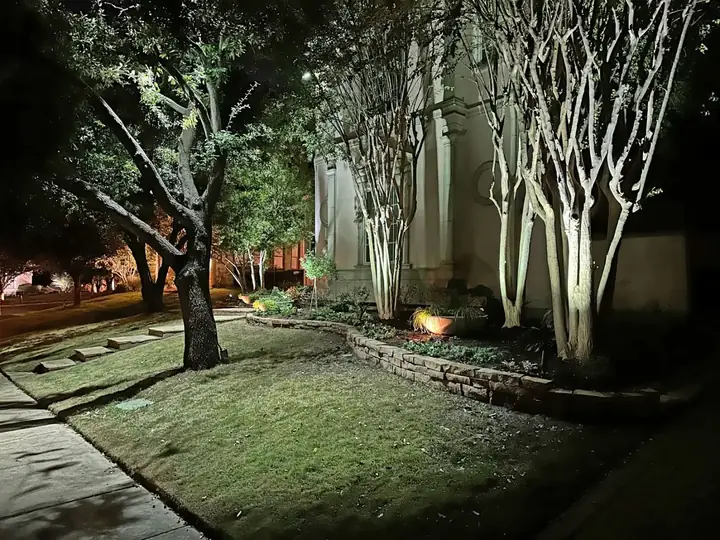
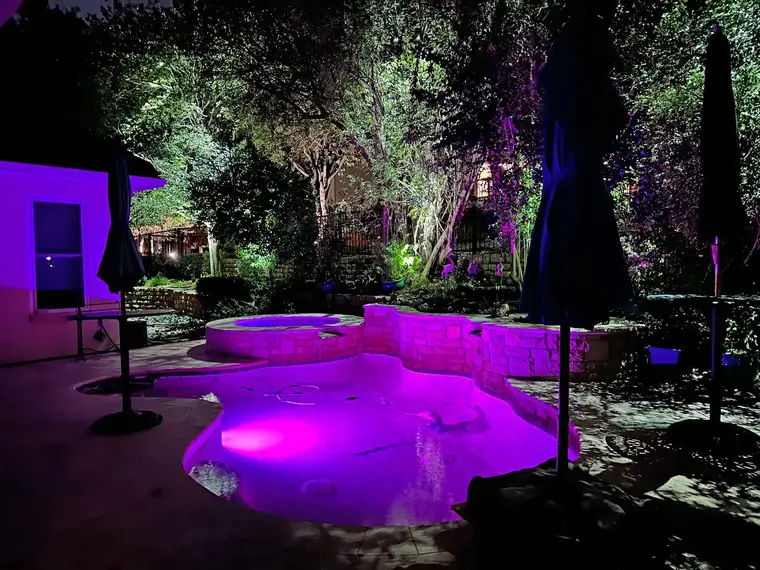
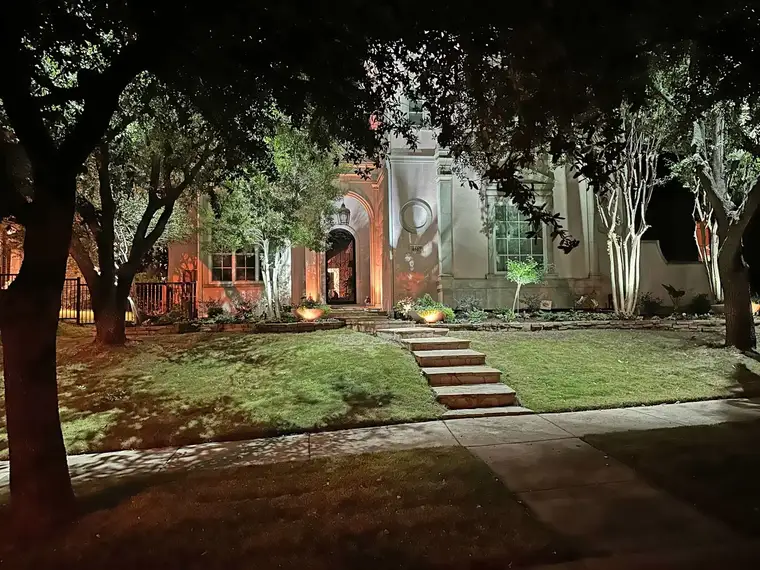
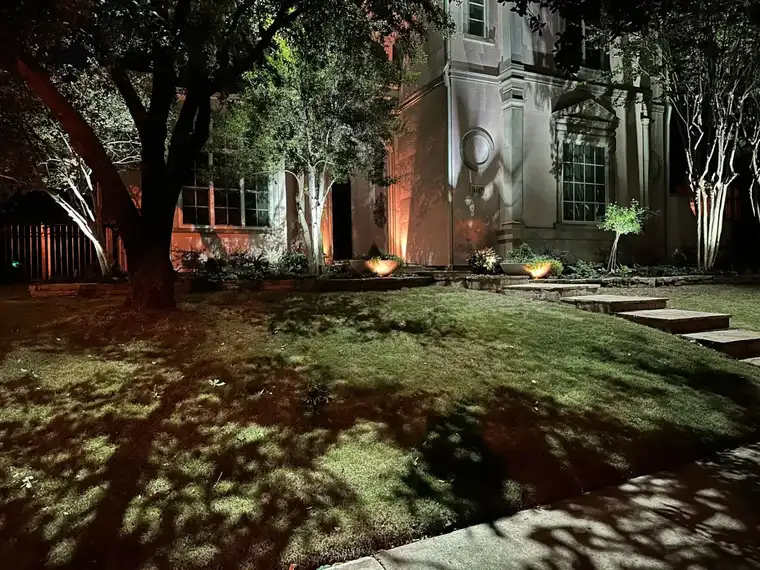
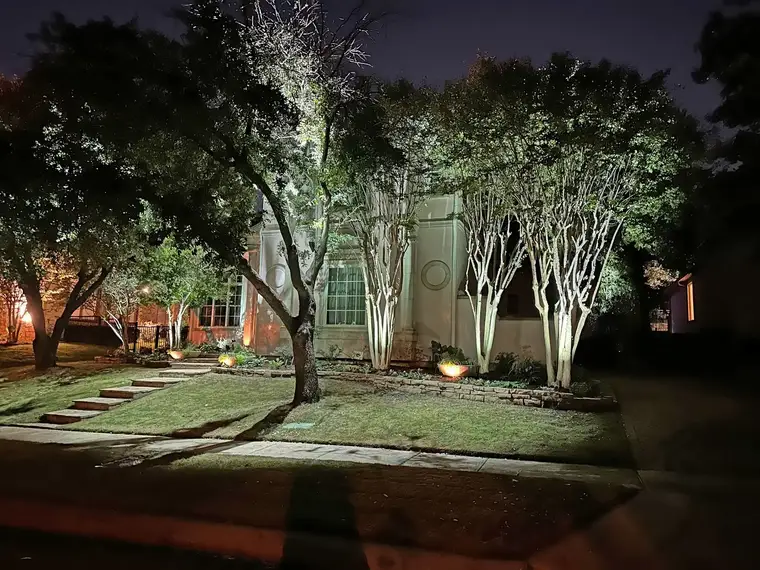
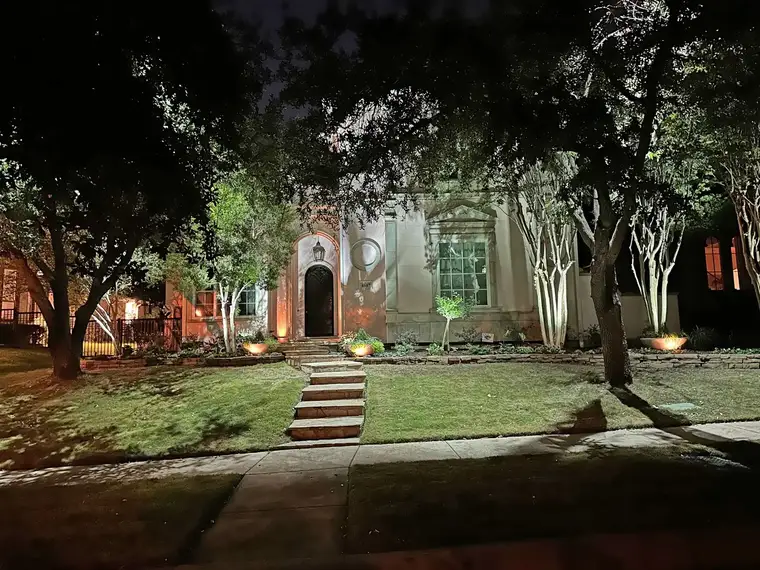
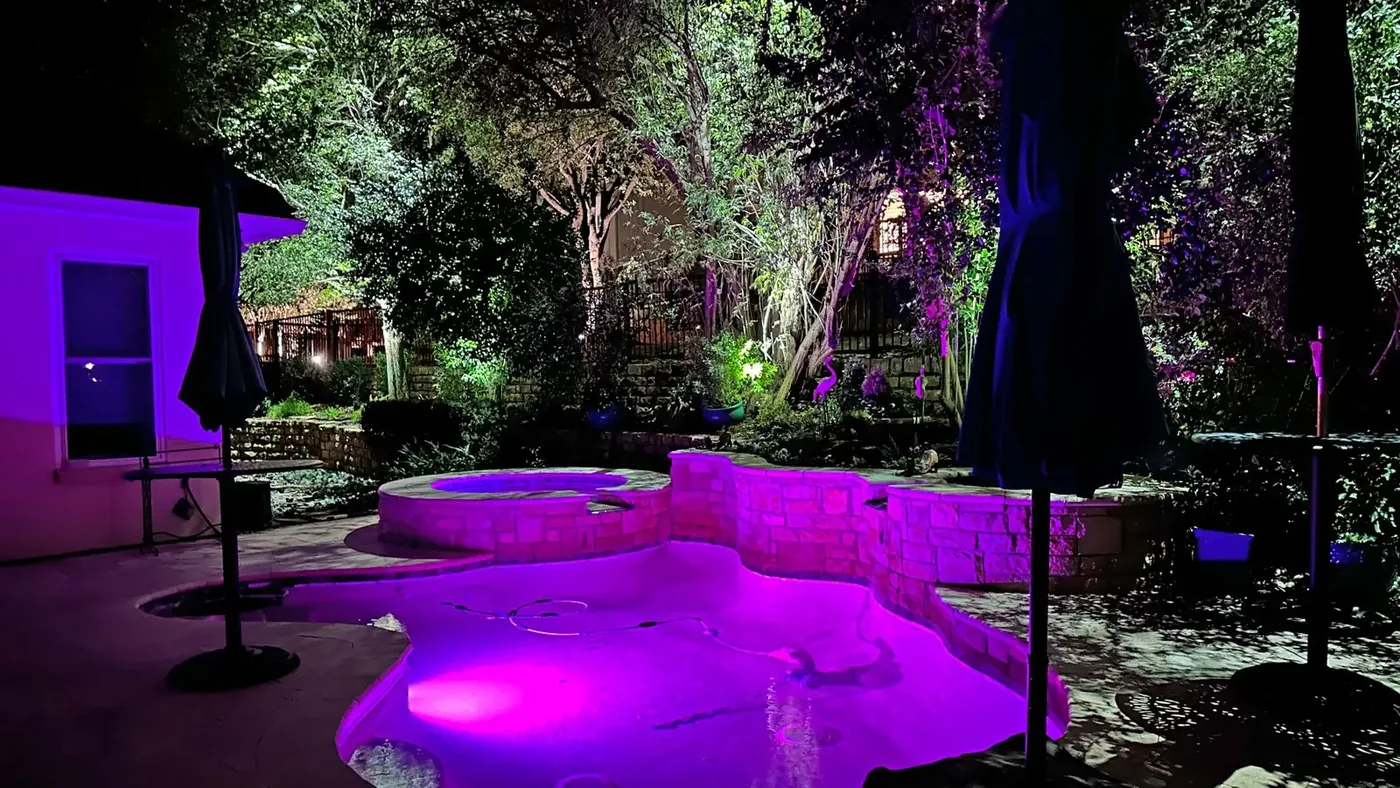
The six photographs on this page are Las Colinas properties, shot after dark on the night each system was aimed. What makes lighting here genuinely different from a suburban lot thirty minutes north is not the architecture, though that is distinctive too. It is the sky. Between the towers, the canal lighting, the roads and the airport beyond, an Irving night has a far higher ambient level than a dark suburban street, and the whole design has to answer that rather than ignore it.

Bright Skies

Where the Night Is Not Dark, Contrast Has to Be Built Rather Than Borrowed

Lighting a garden in a dark suburb is easy in one specific respect: the background is black, so almost anything you light stands out. In an urban centre that free contrast is gone. Ambient light from towers, street lighting, the canal and the airport raises the whole scene, and the effect is that a scheme which would look generous in Flower Mound looks washed out and slightly pointless here.

The instinct is to compensate by turning everything up. That is the wrong move and it is worth understanding why. Raising every output raises the floor along with the ceiling, so the ratio between lit and unlit — which is what the eye actually reads — does not improve. You end up with a brighter garden that still looks flat, and a running cost and a glare problem you did not have before.

What works is the opposite: fewer subjects, tighter beams, and genuinely dark ground between them. Pick three or four things on the property that deserve to be lit — a specimen tree, an entry, a run of wall, a water edge — light those properly with controlled optics, and leave everything else alone. Against a bright sky a few well-lit objects read as deliberate. Twenty moderately-lit ones read as haze. This is the single biggest difference between a scheme designed for Las Colinas and a suburban plan transplanted into it.

Built Water

A Canal Is Not a Pond: the Edges Are Vertical and the Surface Is Still

Natural water in a garden has soft, sloping, planted edges. The water in Las Colinas is engineered — masonry walls going straight down into a surface that is usually glass-still, with hard copings and steps at the margin. That changes the lighting in three ways that matter.

The reflection is a true mirror. On still water with a hard edge, anything lit near the margin appears twice, the right way up and upside down, with almost no distortion. That is an asset if the thing being reflected is worth seeing, and a liability if it is a glare source, because a visible lamp becomes two visible lamps. Every fixture near a canal edge gets checked from the far side of the water, not just from the garden.

The vertical wall is a surface in its own right. Masonry going down into water takes grazing light extremely well, and lighting the wall rather than the water gives you a lit edge that defines the whole shape of the channel after dark.

The margin is a safety line. A vertical drop into water, with steps and a coping at the edge, wants the coping and the treads legible at night as a matter of course. That is low-level, shielded, downward light — circulation rather than effect — and it is the part of the scheme we will not leave out. The hardscape and site lighting page covers how that work is built.
Flat Rooflines

A Contemporary Elevation Gives You Nowhere to Hide a Fixture

Las Colinas has a high proportion of contemporary houses — flat roofs, parapets, rendered planes, large glazed openings — and they present the opposite problem to the ranch houses a few miles east. A pitched roof with a deep eave gives you a built-in concealed mounting position. A parapet gives you none, and a flat rendered plane shows every fitting you put on it.

So the fixtures move off the building and into the ground and the planting. Recessed in-grade uplights set into paving or gravel at the base of a wall disappear completely by day and graze the plane cleanly at night, which suits render far better than a surface-mounted fitting would. Where there is a parapet, lighting the underside of its overhang from below gives you a strong horizontal line that follows the architecture instead of fighting it.

Large glazing needs thinking about in the other direction. A wall of glass at night is a mirror from inside, so anything bright in the garden is reflected back into the room. Keeping fixture positions out of the direct line of sight from the main seating position inside, and keeping output down close to the glass, is what stops a beautiful garden scheme from making the living room unusable after dark. It is a detail that gets found on the night-set and almost never in daylight.

Irving Beyond the Towers

Most of Irving Is Not Las Colinas, and It Is a Simpler Job

It would be a distortion to write this page entirely about the urban centre. Irving is a large, old city: established neighbourhoods south and east of Las Colinas with mature trees, ordinary lots and houses several decades older than anything on the canal. Those are the straightforward version of our work, and the techniques are the ones used on properties all over the Metroplex.

On those lots the ambient-light argument above largely falls away, the trees do the heavy lifting, and the questions are the usual ones: what the subject of the elevation is, where the transformer goes, how many zones you want, and whether the trees are mature enough to be lit from above. The Dallas page covers that version of the job in more detail, since the ground and the tree stock are the same.

Either way the process does not change. Todd walks the property himself in daylight, you get a written plan with a fixed price and dates before anything begins, and the fixtures are aimed after dark on a separate evening — which, in a place with this much ambient light, is the evening that decides whether the scheme works.

What Clients Say

What Clients Have Written

No Irving client has written to us yet, so rather than dress a letter from somewhere else up as a local one, here are three from elsewhere in the service area with the towns they were written from. All thirty-one are on the reviews page in full.

”
★★★★★

“I'm so pleased with the landscape lighting recommendation. Todd and his team did an amazing job on our lighting! Thank you again. Khurrum and I really appreciate it.”

D
Mr. & Mrs. Dhanji
Southlake, TX
Client Letter
”
★★★★★

“Todd and his team simply do great work!”

VM
Vance Minter
Fort Worth, Texas
Client Letter
”
★★★★★

“The work and design you did are excellent. The lighting around our yard highlights the exterior of our home and gives a pleasant, subtle ambiance outside to enjoy after dark. We use our backyard and pool much more than before the lights were installed…”

SC
Stephen Cavender
Dallas, Texas
Client Letter

Read all thirty-one client letters →

Where This Is

Irving, TX, TX — and How Far It Is From Us

Dallas County, between the Trinity and DFW Airport, about twelve miles south-west of Carrollton. Free on-site design visit, and Todd comes out himself.

Irving, TX, TX · inside the TC Lighting service area · free on-site design visit

Common Questions

Irving Landscape Lighting Questions

Have you worked in Las Colinas?

Yes. The six photographs on this page are Las Colinas properties, shot after dark on the night each system was aimed. They are TC Lighting installations, not stock imagery or renderings.

Our garden never looks dark enough for the lighting to show. What can be done?

Not more light, which is the usual instinct and makes it worse by raising the floor as well as the ceiling. The answer is fewer subjects, tighter beams and genuinely dark ground between them. Against a bright urban sky three or four properly lit things read as deliberate where twenty moderately lit ones read as haze.

We are on the canal. Does the water need special treatment?

It needs checking from the far side. Still water with a hard masonry edge is a true mirror, so any fixture visible near the margin appears twice. We aim and check canal-side fixtures from across the water as well as from the garden, light the vertical wall rather than the surface, and treat the coping and any steps as a safety line that gets lit regardless.

Our house is contemporary with a flat roof. Where do the fixtures go?

Into the ground rather than onto the building. A parapet gives you no concealed mounting position and a rendered plane shows every fitting, so recessed in-grade uplights set into paving or gravel at the base of a wall are usually the answer -- invisible by day and a clean graze at night.

We have a lot of glass. Will the lighting reflect into the house?

It can, and that is a design decision rather than an accident. Glazing is a mirror from inside at night, so we keep fixture positions out of the direct sight line from the main seating position and keep output down close to the glass. It is one of the things found on the night-set and almost never in daylight.

Do you work in the rest of Irving, or only Las Colinas?

All of it. The older neighbourhoods south and east have mature trees and ordinary lots, and they are the straightforward version of this work -- the ambient-light problem largely falls away and the trees carry the scheme.

Nearby

Where Else Todd Works Near Irving

Free On-Site Design Visit

Ask Todd About Your Irving Property

Four fields, about fifteen seconds. Send the address and what you are hoping to light. Todd walks the property himself, in daylight, and you get a written plan with a fixed price and dates before any work begins.

  • Free, no-obligation design visit and written plan
  • Licensed Texas Electrical Contractor — TECL 41495
  • Conduit-protected wiring and daily site cleanup
  • Every fixture day-set, and a night-set on most projects

Prefer to talk? Call (972) 345-1180.

Request Your Free Design Visit

See What Your Property Looks Like After Dark

Free on-site design visit anywhere in Dallas–Fort Worth. You will talk to Todd, not a call center.

(972) 345-1180
Licensed Texas Electrical Contractor TECL 41495 · Free Design Visits
Book My Free Design Visit
(972) 345-1180
Landscape Lighting · Dallas–Fort Worth Metroplex
Free Design Visit